

 Academic Frontier
IF: 10.2! New breakthrough in dual-responsive hydrogel: Mild photothermal therapy regulates HSP70 to aid spinal cord mitochondrial repair
QQ Academic Group: 1092348845
Detailed
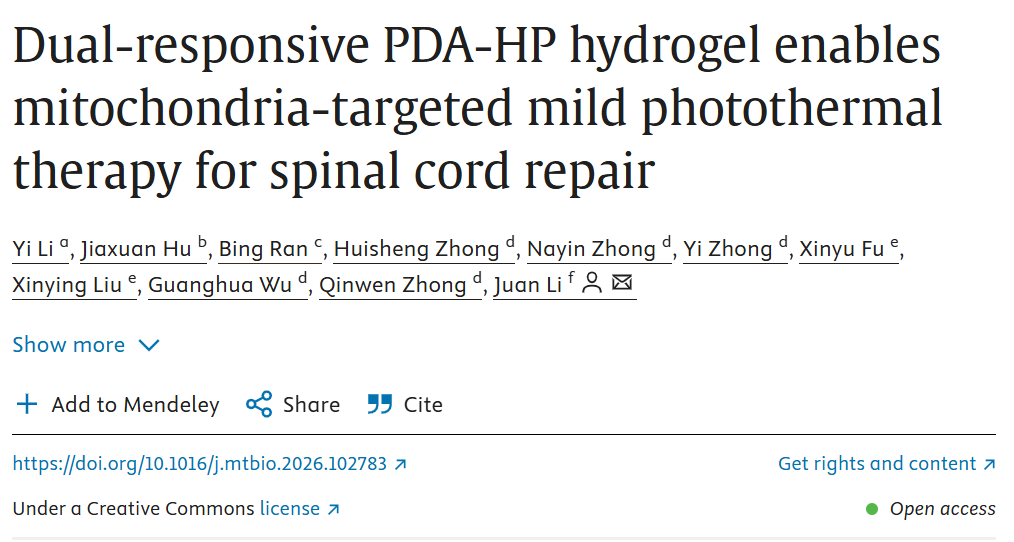
This article addresses the complex pathological microenvironment and the difficulty of neural regeneration following spinal cord injury by developing a dual-responsive hydrogel (PDA-HP) based on polydopamine (PDA) and heparin-poloxamer (HP). Through mild photothermal stimulation controlled by near-infrared light, it regulates mitochondrial function and stress responses to promote spinal cord injury repair.The study validated the potential of this hydrogel in improving motor function and reducing tissue damage through animal models, and revealed its molecular mechanism of action in regulating heat shock proteins and mitochondrial pathways using proteomics. The related research results were published in Materials Today Bio (IF 10.2).
Innovations
01
Dual-Responsive Design
PDA-HP hydrogel possesses both near-infrared light and temperature responsiveness, enabling precise spatiotemporal control of the photothermal effect and preventing excessive thermal damage.
02
Gentle Photothermal Therapy
By applying mild thermal stimulation (non-high-temperature ablation) to regulate mitochondrial metabolism, it restores ATP production and reduces oxidative stress and cell apoptosis.
03
Dynamic Regulation of HSP70
For the first time, it was discovered that PDA-HP-mediated photothermal therapy can reverse abnormally high HSP70 expression induced by spinal cord injury, thereby maintaining protein homeostasis and neuron survival.
Original Source
Journal Name: Materials Today Bio
Publication Date: January 14, 2026
DOI: 10.1016/j.mtbio.2026.102783
Research Team: Yi Li, Jiaxuan Hu, Bing Ran, et al. (The team focuses on interdisciplinary research between biomaterials and neural engineering).
- Previous: Advanced Functional Ma
- Next: Advanced Science | Imm


