

 Nanomedicine
Bone Immunity Idea | Anxiety Fracture Nano Immunity
QQ Academic Group: 1092348845
Detailed
 Summary:
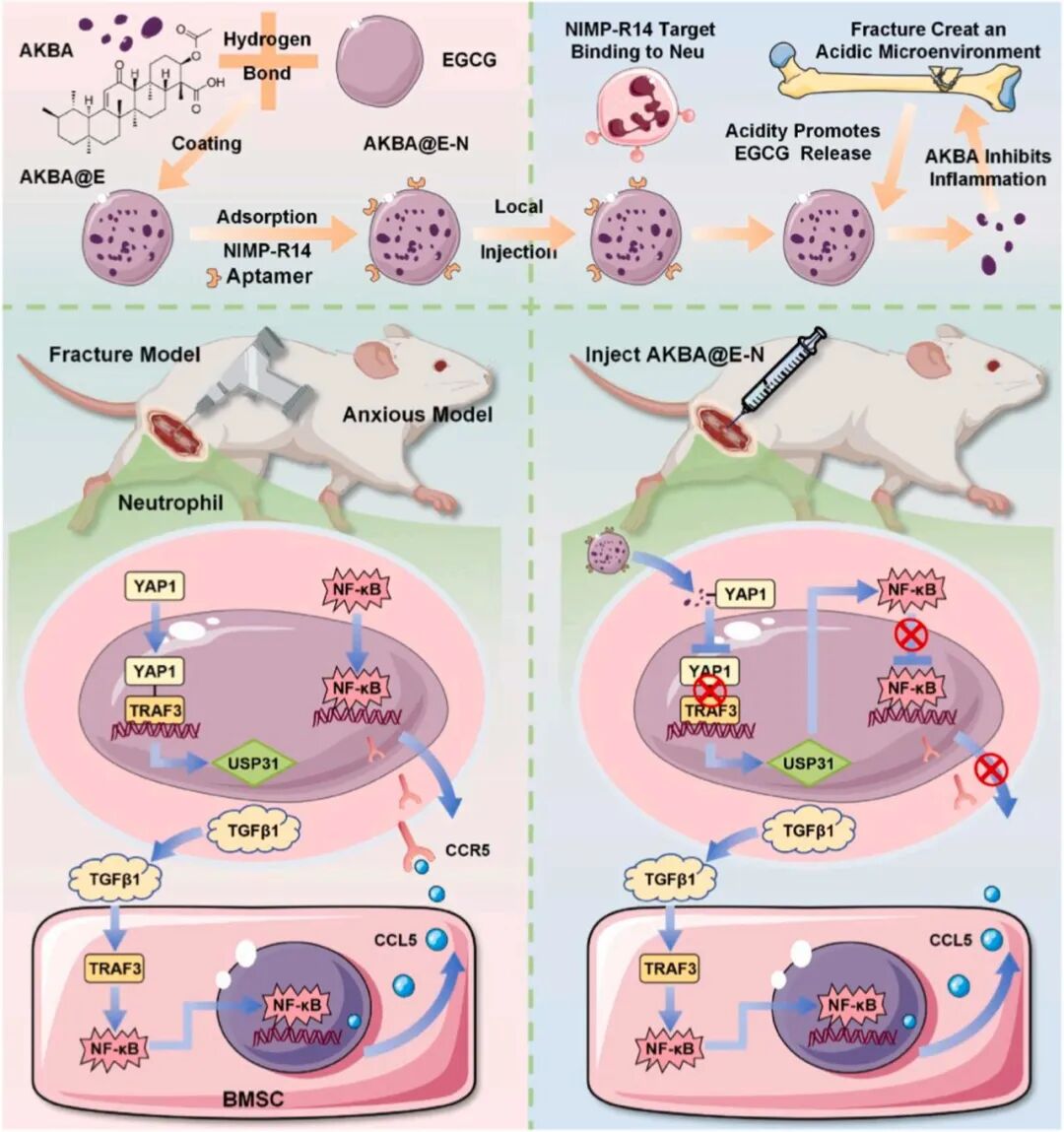
Anxiety hinders fracture healing through unclear immune pathways. In a mouse stress-fracture model, TGFβ1⁺CCR5⁺ neutrophils suppress BMSC osteogenesis via TGFβ1, while BMSC-secreted CCL5 further activates these neutrophils, forming a vicious loop sustained by the NF-κB-CCR5 axis. AKBA targets YAP1-USP31 to suppress NF-κB/CCR5 signaling and relieve this inhibition. An NIMP-R14 aptamer-functionalized EGCG nanocarrier (AKBA@E-N) boosts local neutrophil uptake and retention at acidic fracture sites, effectively accelerating fracture repair.
01
Research Background
Delayed fracture healing is a tough problem in orthopedics, and anxiety or depression is linked to more bone loss, higher fracture risk, and slower healing. Fracture healing depends on orderly inflammation, with neutrophils arriving at the injury site first, and their functional state affects repair. Bone marrow TGFβ1+CCR5+ double-positive neutrophils are regulators of bone metabolism, and they abnormally expand in age-related bone loss, driving bone mass decline. But it’s still unclear whether anxiety delays fracture healing through this subgroup, and current treatments lack targeted strategies for this immune mechanism.
02
Main Content
The study focuses on how anxiety affects fracture healing through neutrophils and how targeted interventions work. A CRS anxiety combined with femur fracture model was established, confirming that anxiety increases TGFβ1+CCR5+ double-positive neutrophils and impairs healing. This subset secretes TGFβ1, which inhibits BMSC osteogenesis, while CCL5 from BMSCs promotes neutrophil activation in return, forming a positive feedback loop. CRS activates the NF-κB-CCR5 axis; AKBA binds to YAP1, upregulates USP31, inhibits NF-κB phosphorylation and CCR5 expression, reduces the pathogenic subset, and restores osteogenesis. Furthermore, an NIMP-R14 aptamer-modified EGCG nanocarrier was developed to achieve neutrophil targeting and acid-responsive release.
03
Research Design
We used CRS to induce anxiety and created a mouse femur fracture model to assess behavior, hormones, and healing. Bone marrow neutrophils were isolated, and double-positive subpopulations were detected by flow cytometry. Transwell co-culture was used to compare the effects of different ratios of neutrophils on BMSC osteogenesis, along with adoptive transfer. Mechanistically, we combined transcriptomics, molecular docking, immunofluorescence, WB, qPCR, siRNA, and point mutation experiments to validate the YAP1-USP31-NF-κB-CCR5 axis. AKBA@E-N was constructed and characterized for release, drug loading, biocompatibility, and antibacterial properties; in vivo comparisons of free AKBA, AKBA@E, AKBA@E-N were performed to evaluate targeting, pharmacokinetics, imaging, and histology.
04 Results
CRS triggers anxiety, elevates TGFβ1⁺CCR5⁺ neutrophils in bone marrow and fracture sites, downregulating osteogenic markers and delaying fracture healing. This subset suppresses BMSC osteogenesis dose-dependently, and its adoptive transfer worsens repair. AKBA depletes this pathogenic subset and rescues BMSC osteogenesis. Mechanistically, AKBA binds YAP1 to relieve its suppression on USP31, inhibiting NF-κB activation and CCR5 expression; YAP1 overexpression or USP31 knockdown reverses these effects. The acid-responsive, neutrophil-targeted AKBA@E-N nanocarrier exhibits favorable biocompatibility, local retention and superior healing efficacy over free AKBA in the anxious fracture model.
Original Source:
Bioactive Materials,
2026 DOI: 10.1016/j.bioactmat.2026.09.028
Ouyang L, Zhang Y, Liao J, et al.
We specialize in custom nano-medical functional materials. We conduct targeted development to tailor structure, particle size and surface modification for your experiments. Full characterization, iterative optimization and technical support are available for targeted delivery, bioimaging and nanomedicine studies. Send your evaluation plans to us. Engineer Zhang: 17715390137 Engineer Chen: 18914047343
- Previous: Bone Immunity Idea|Usi
- Next: Frontiers of Medical E


