

 Nanomedicine
SusMat | Making ultrathin 2D MOF electrocatalysts by reducing the dimensionality of 3D metal-organic frameworks (MOFs) and tweaking their electronics to boost oxygen evolution reaction performance
QQ Academic Group: 1092348845
Detailed
 Synthesizing two-dimensional metal-organic frameworks (2D MOFs) from non-layered three-dimensional (3D) precursors is still a tough challenge. This paper reports a dimensionality-reduction method that turns three-dimensional zeolitic imidazolate framework-67 (ZIF-67) into ultra-thin 2D MOF nanoribbons. The process is mediated by the controlled formation of a yolk-shell layered ZIF-67@CoNi layered double hydroxide (LDH) intermediate, which undergoes ligand-exchange-induced recrystallization. By tuning the organic linkers with ─NH2 (electron-donating) and ─NO2 (electron-withdrawing) groups, we achieved precise control over the resulting MOF morphology and the electronic structure of its metal centers. The electron-rich 2D CoNi NH2─BDC MOF shows outstanding oxygen evolution reaction (OER) performance, achieving an overpotential of 288 mV at 10 mA cm−2 and excellent stability for over 264 hours, outperforming commercial RuO2. This work provides a general approach for converting 3D MOFs into 2D MOFs and highlights the critical role of morphology and linker electronics in determining electrocatalytic performance.

This work was published in SusMat entitled “Dimensional Reduction and Electronic Modulation of 3D MOFs to Ultrathin 2D MOF Electrocatalysts for Enhanced Oxygen Evolution”.
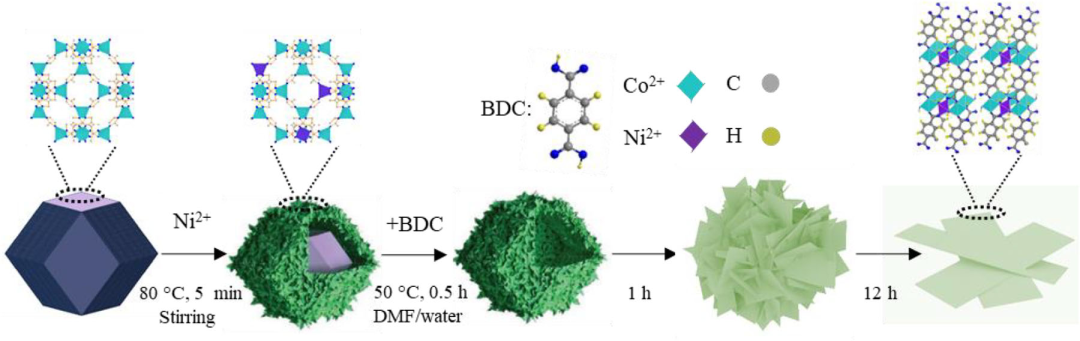
Figure 1
Schematic of synthesizing 2D CoNi BDC MOF nanobelts through yolk-shell ZIF-67@CoNi LDH intermediate
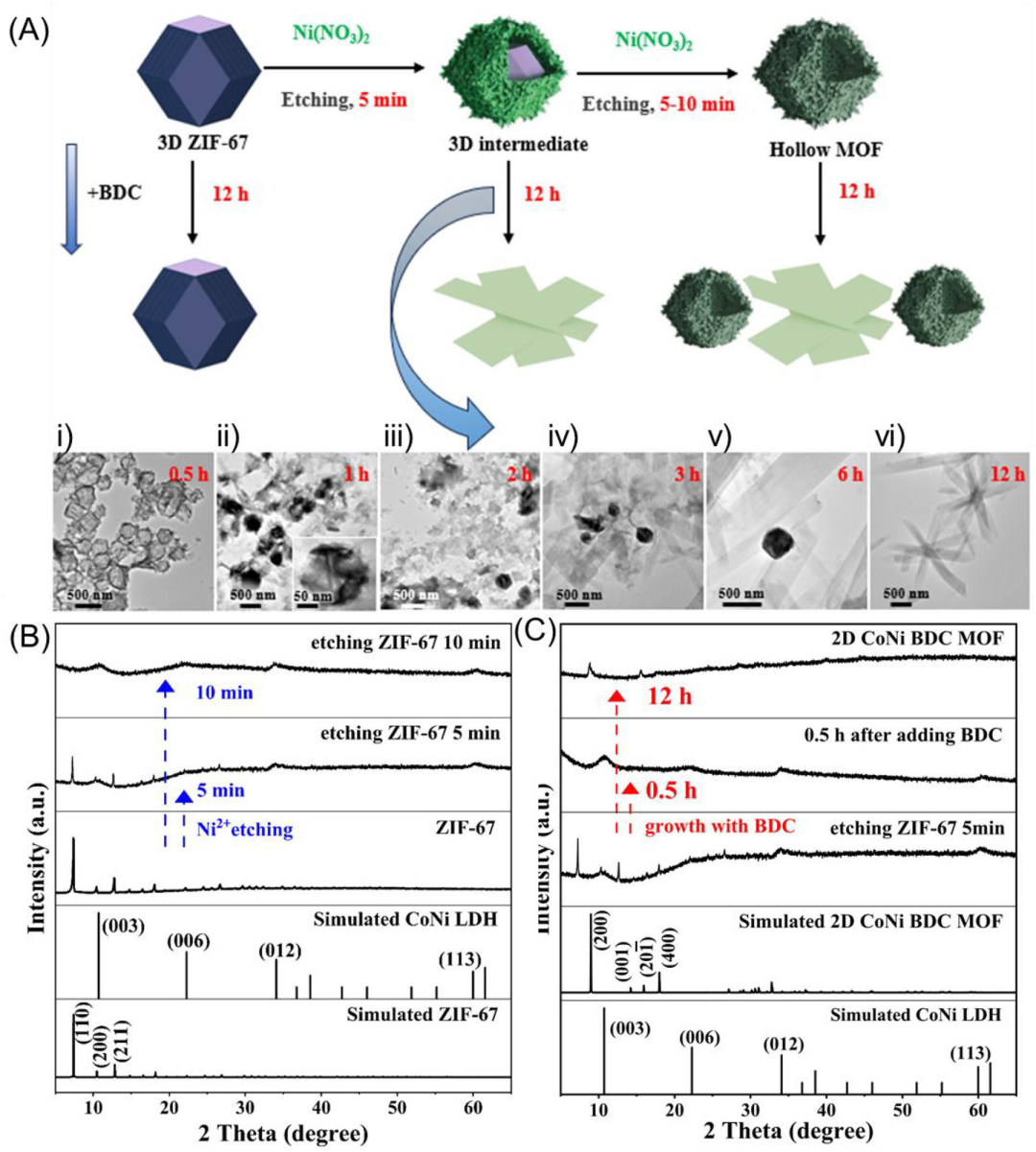
Figure 2
Morphology and structural evolution from ZIF-67 to 2D MOF. (A) Schematic and corresponding TEM images showing the time evolution of ZIF-67 during the etching process, eventually forming 2D ErBeBDC sheets. (B) XRD patterns tracking the phase changes of ZIF-67 during etching at 0, 5, and 10 minutes. (C) XRD patterns of different samples during MOF growth.
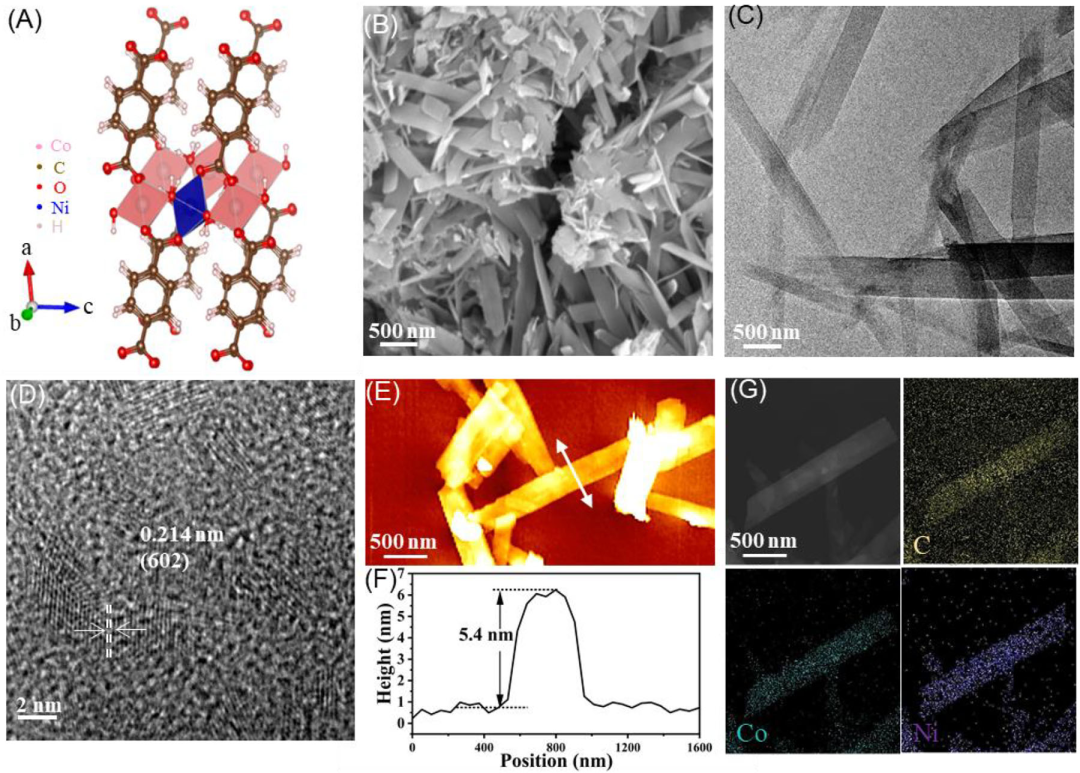
Figure 3
Structure and composition characterization of 2D CoNi BDC MOF. (A) Proposed crystal structure model. (B) SEM and (C) TEM images revealing the nanoribbon structure. (D) HRTEM image showing lattice fringes. (E) AFM image, (F) corresponding height profile, confirming the ultrathin nature. (G) HAADF-STEM image and corresponding elemental maps (C, Co, and Ni), showing the uniform distribution of elements.
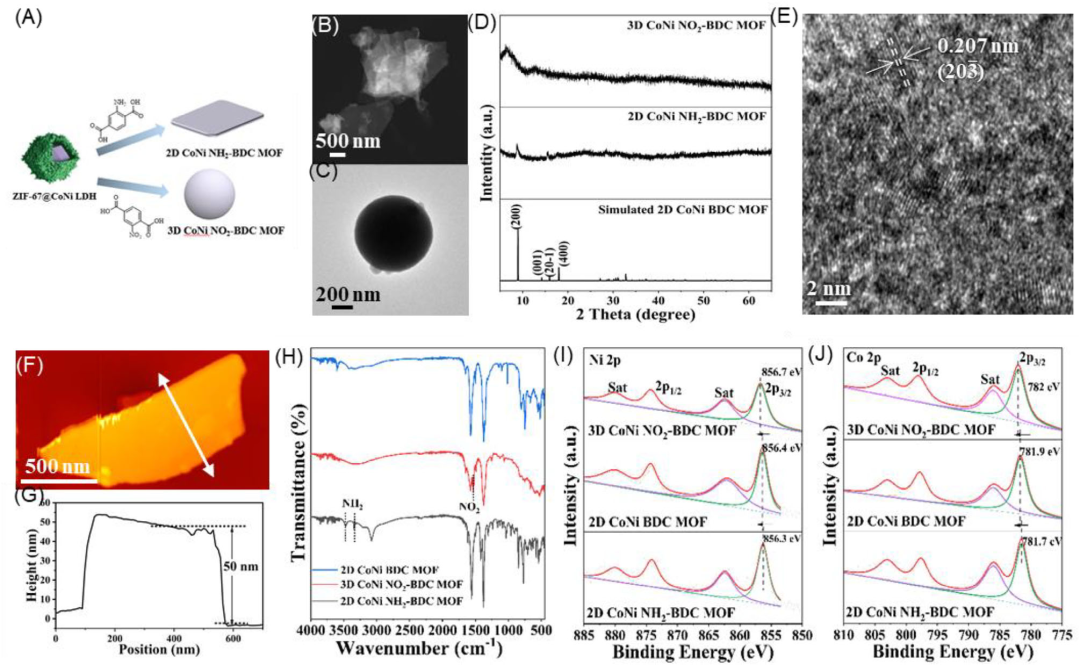
Figure 4
Electronic connector modulation and its effect on multi-molecular structures. (A) Schematic of 2D CoNi NH synthesis ─ 2─BDC MOF and 3D CoNi NO2─BDC MOF; (B, C) TEM images comparing CoNi with different NH forms: 2─BDC (2D nanoribbons) and CoNi─NO2─BDC (3D structure). (D) XRD patterns; (E) HRTEM image of 2D CoNi NH ─ 2─BDC MOF nanoribbons. (F) AFM image and (G) the corresponding height profile. (H) FT-IR spectra of the three MOFs. High-resolution XPS spectra of the three MOFs: (I) Ni 2p and (J) Co 2p regions.
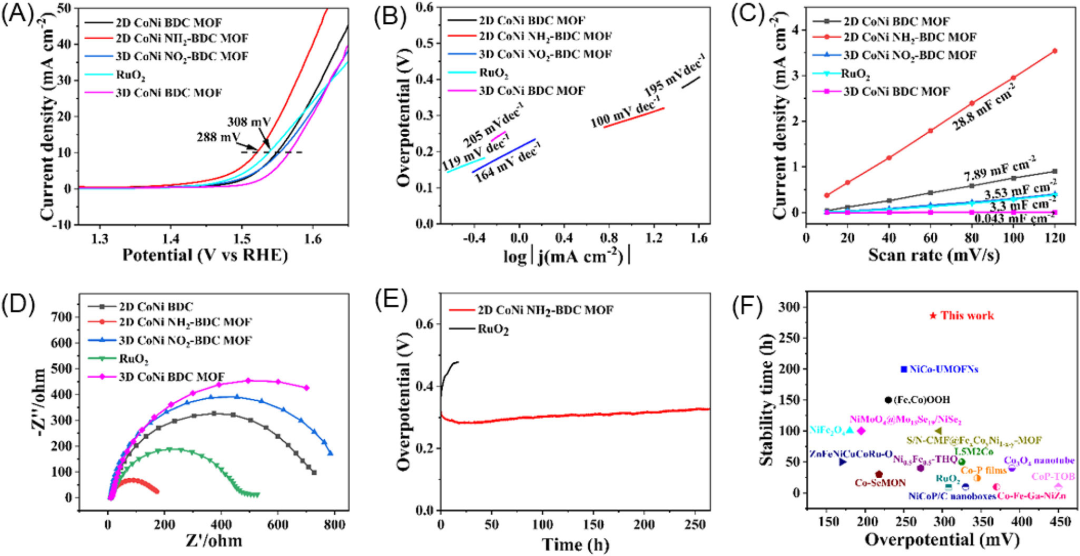
Figure 5
Electrocatalytic OER performance. (A) LSV curves, (B) the corresponding Tafel plots, (C) electrochemical double-layer capacitance (CDL), (D) Nyquist plots of electrochemical impedance spectroscopy (EIS), and (E) time–potential stability tests of 2D CoNi BDC MOF, 2D CoNi NH2─BDC MOF, 3D CoNi NO2─BDC MOF, RuO2, and 3D CoNi BDC MOF. (F) Comparison of overpotentials at 10 mA cm−2 and the stability duration of 2D CoNi NH2─BDC MOF with other reported high-performance OER catalysts in 1M KOH.
Summary
Starting from non-layered 3D ZIF-67, Ni²⁺ was first used to briefly etch it into a yolk–shell ZIF-67@CoNi LDH intermediate. Then, BDC ligand exchange was used to induce recrystallization, reducing it into ultrathin 2D MOF nanobelts. The key is not to over-etch the intermediate, otherwise a pure 2D structure cannot be obtained. Afterwards, the electronic properties of the linkers were tuned with –NH₂ and –NO₂, simultaneously controlling both morphology and the electronic density at the metal centers. Electron-rich 2D CoNi NH₂-BDC achieved an OER overpotential of 288 mV at 10 mA cm⁻² and remained stable for over 264 hours.
In a cisplatin-induced acute kidney injury model, oral CeO2@LP@EL alleviated kidney dysfunction and fallopian tube damage, while also repairing the gut barrier, reducing endotoxemia and inflammation, suppressing oxidative stress, remodeling gut microbiota, protecting mitochondria, and restoring related kidney transcriptional changes. These results suggest that gut gating can serve as a practical design principle for nano–bio hybrids, linking probiotic activity with nanozyme redox regulation and promoting gut-directed repair and protection.
Reference:
DOI:10.1002/sus2.70100
We specialize in custom nano-medical functional materials. We conduct targeted development to tailor structure, particle size and surface modification for your experiments. Full characterization, iterative optimization and technical support are available for targeted delivery, bioimaging and nanomedicine studies. Send your evaluation plans to us.
Engineer Zhang: 17715390137
Engineer Chen: 18914047343
- Previous: Advanced Materials | M
- Next: Frontiers of Medical E


