 Featured Article
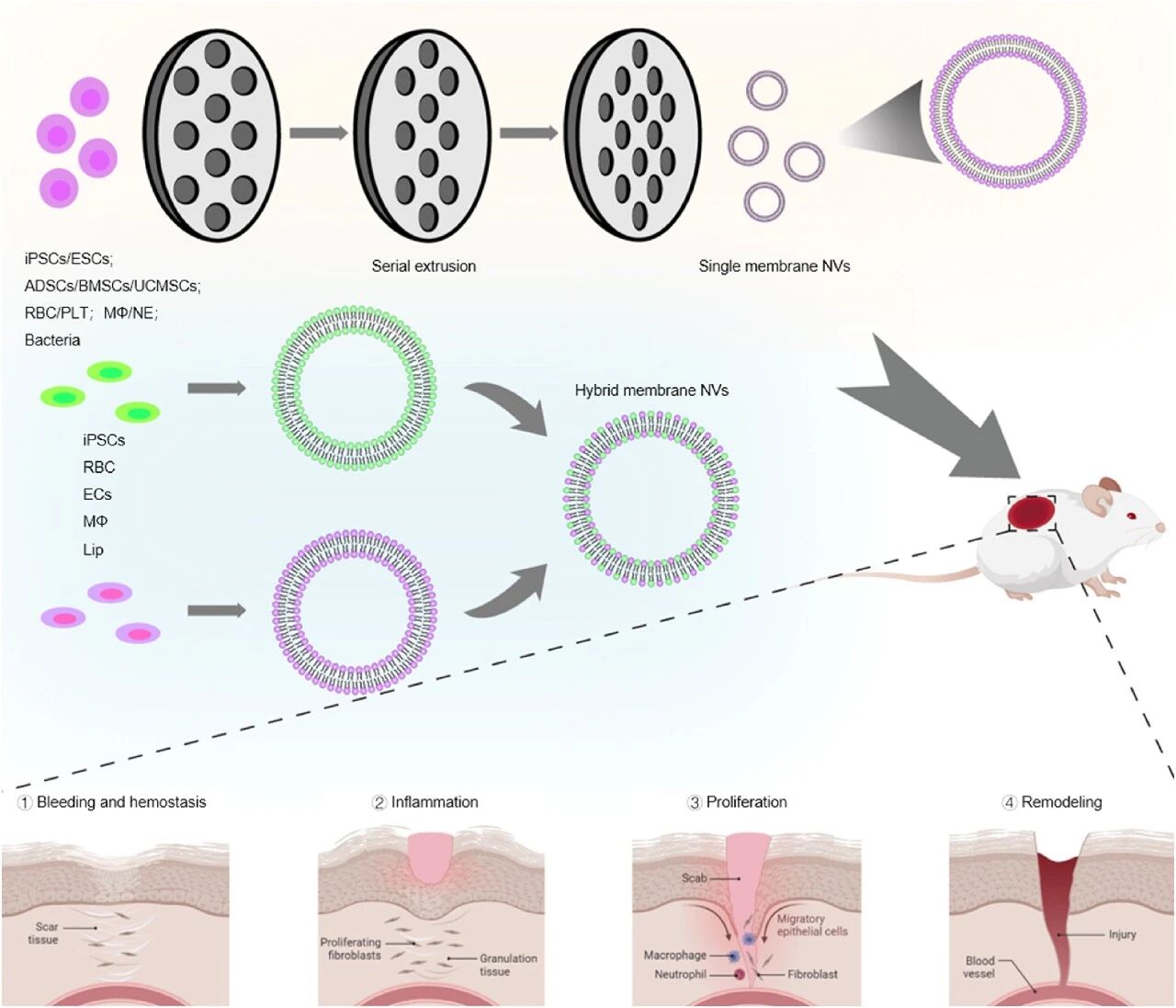
Cell membrane-derived nanovesicles (NVs) have emerged as a promising alternative to extracellular vesicles (EVs) for wound healing applications, addressing the limitations of traditional EVs, including insufficient targeting ability, low yield, and limited drug-loading capacity. Through mechanical cell extrusion methods, NVs exhibit excellent characteristics, showing higher yield, stability, and purity compared to natural EVs.These NVs can originate from various membrane sources, including single-cell types (stem cells, blood cells, immune cells, and bacterial membranes), hybrid cell membranes, and cell membranes mixed with liposomes, each with unique therapeutic properties. The integration of genetic engineering and surface modifications further enhances NV functionality, enabling precise targeting and improved drug delivery capabilities.Recent advances in NV-based therapies have demonstrated their potential in multiple biomedical applications. Although challenges remain in standardization, storage stability, and clinical translation, the combination of naturally derived cellular functions with the potential for artificial modification makes NVs a promising platform for next-generation therapeutic delivery systems, thereby offering new possibilities for wound healing applications.Finally, we explored the challenges and future prospects of translating NV-based therapies into clinical practice, providing insights into the future development of this innovative approach in wound healing and tissue repair.
Innovative Points
Cell membrane-derived nanovesicles (NVs) have achieved significant breakthroughs in preparation methods. By using mechanical extrusion as a physical approach, their yield and purity are greatly increased. Compared to traditional extracellular vesicle (EV) isolation techniques, this method avoids complex ultracentrifugation steps and better preserves the integrity and stability of the vesicle membrane, laying the process foundation for large-scale, standardized production.At the same time, this method can flexibly accommodate different cell sources, making it possible to scale up the preparation of nanocarriers with specific biological functions, addressing the core bottlenecks of low yield and batch variability of natural EVs.
Original link
Cell membrane-derived nanovesicles as extracellular vesicle-mimetics in wound healing
Materials Today Bio ( IF 10.2 )
Pub Date : 2025-02-18
DOI: 10.1016/j.mtbio.2025.101595
Wenwen Li, Huihui Zhang, Lianglong Chen, Chaoyang Huang, Ziwei Jiang, Hai Zhou, Xinxi Zhu, Xiaoyang Liu, Zesen Zheng, Qiuyi Yu, Yufang He, Yanbin Gao, Jun Ma, Lei Yang