已传文件:photo/1769738012.png
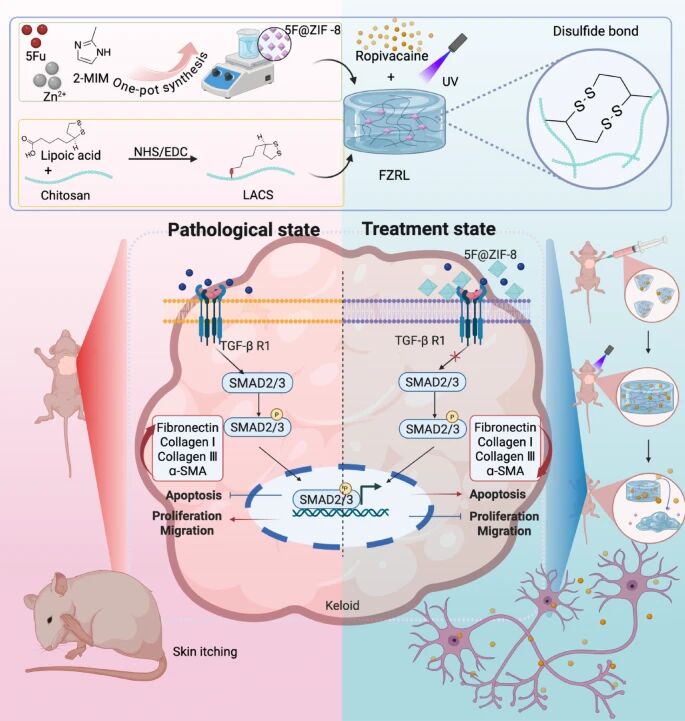
 As a fibroproliferative disorder, keloids are difficult to treat, and traditional methods often struggle to address their complex pathological mechanisms. This study developed an injectable nano-composite hydrogel system based on lipid acid-conjugated chitosan (FZRL), which achieves precise scar treatment by encapsulating 5-fluorouracil-loaded ZIF-8 nanoparticles and ropivacaine.
Studies have shown that under mild ultraviolet light, the hydrogel precursor can quickly crosslink to form a stable three-dimensional network, effectively maintaining drug activity and preventing premature leakage. In the acidic scar microenvironment, the hydrogel specifically degrades and controls drug release, regulating the TGF-β/SMAD pathway, inhibiting fibroblast proliferation and abnormal angiogenesis, modifying the extracellular matrix structure, and alleviating itch-related behaviors. This study provides new materials and ideas for scar treatment.
 Innovative Points
01
Dual-Responsive Design
This study innovatively integrates ultraviolet (UV) light-responsive crosslinking with a pH-triggered drug release mechanism into a single hydrogel platform. The material remains liquid before injection, allowing for precise delivery; upon mild UV exposure, it rapidly crosslinks to form a stable three-dimensional network, enabling long-term local retention of the drug. This dual-responsive feature addresses the issues of poor targeting and burst drug release commonly seen in traditional drug delivery systems.
02
Multi-Drug Synergistic Delivery System
The study developed a dual-drug loading system containing the anti-fibrotic drug 5-fluorouracil and the local anesthetic ropivacaine. 5-fluorouracil exerts its anti-scar effect by inhibiting excessive fibroblast proliferation, while ropivacaine directly targets scar-associated itching and pain. The two drugs are orderly loaded via nanocarriers, achieving a synergistic therapeutic effect.
03
Multidimensional Scar Treatment Strategy
This study moves beyond the traditional concept of merely inhibiting scar growth and proposes a comprehensive treatment strategy that simultaneously regulates ECM remodeling, inhibits abnormal angiogenesis, and alleviates local symptoms. The hydrogel not only modifies the extracellular matrix structure but also improves therapeutic outcomes and patient quality of life by reducing itch-related behaviors.
Material Development
Material / material
This study uses lipid acid-conjugated chitosan (LACS) as the hydrogel matrix, encapsulating 5-fluorouracil-loaded ZIF-8 nanoparticles (5Fu@ZIF-8) and the local anesthetic ropivacaine to form the FZRL composite hydrogel system.
Function / Function
This material possesses dual functional properties of UV-triggered crosslinking and pH-responsive drug release. It maintains liquid flowability in the pre-injection in vitro state for easy handling; rapidly solidifies into a gel state after mild UV irradiation in vivo, providing mechanical support; and specifically degrades in the acidic scar microenvironment, achieving on-demand drug release.
Original Source Journal Name: Journal of Nanobiotechnology
Publication Date: January 24, 2026
DOI: 10.1186/s12951-026-04060-7
Research Team: Jingyu Jin, Chengjie Zhu, Nuoya Wang, Mingji Jin, Yanxin Jin, Heying Jin, Shuang Zhang, Yanhong Zhou, Lei Zhao, Yinli Luo, Zhonggao Gao, Zhehu Jin, Shuangqing Wang