已传文件:photo/1772159209.png
Abstract:
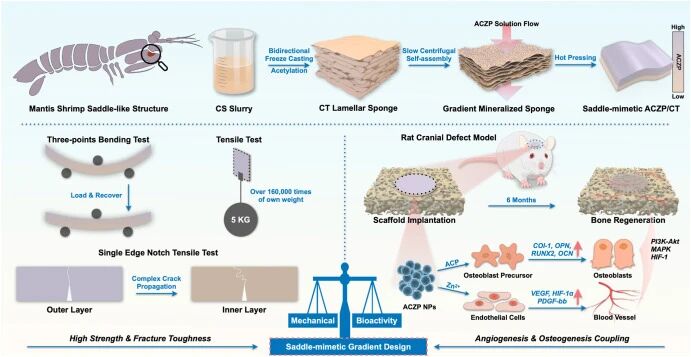
To address the issue of the inability of bone scaffolds to synergize mechanical support with bioactivity, a biomimetic composite scaffold inspired by the mantis shrimp saddle structure was developed. This scaffold possesses both excellent mechanical properties and bioactivity, promoting osteogenesis and vascularized bone formation through ion release and structural induction. At the same time, the molecular signaling pathways mediating bone regeneration were elucidated, providing a new direction for the development of bone regeneration scaffolds.
Research Background
Traditional bone scaffolds struggle to simultaneously meet the requirements for mechanical support and optimal bioactivity, which has hindered research progress in the repair of large bone defects. Developing new scaffolds suited for bone regeneration has become a key research focus.
Main Content
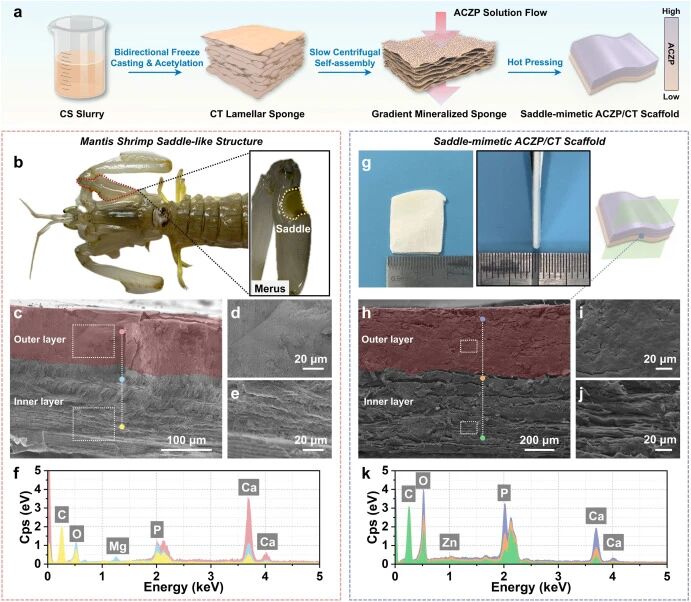
Using the saddle-shaped structure of the mantis shrimp as a biomimetic prototype, zinc-ion-doped amorphous calcium phosphate/chitosan composite scaffolds were prepared to investigate their microstructure, mechanical properties, in vitro bioactivity, and bone defect repair efficacy. Molecular sequencing was used to analyze the molecular mechanisms by which the scaffolds mediate bone regeneration.
Research Design
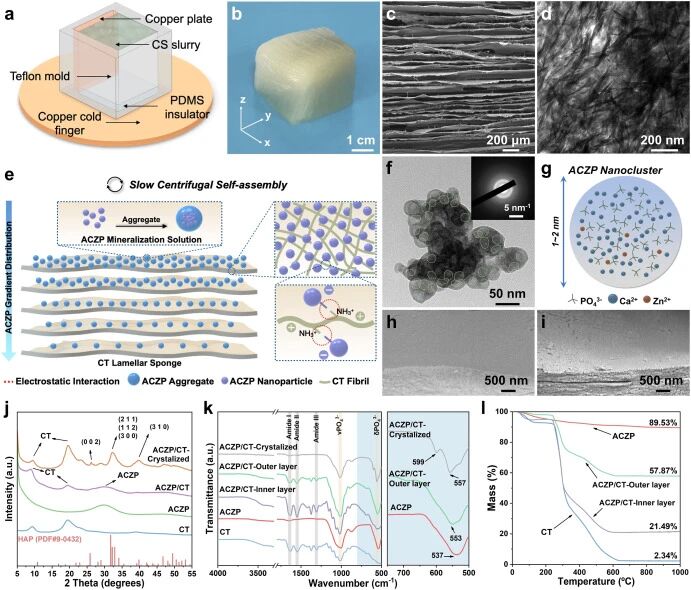
Following an integrated biomimetic approach combining structure, composition, and function, triple saddle-shaped zinc-ion-doped amorphous calcium phosphate/chitosan scaffolds were constructed. The scaffolds retained the characteristics of amorphous nanoclusters and accomplished hierarchical gradient assembly. In vitro experiments were conducted to verify osteogenesis and angiogenesis promotion, while animal experiments evaluated bone defect repair efficacy. Sequencing analyses were performed to study the signaling pathways involved in bone regeneration.
Results
The prepared scaffolds maintained the amorphous nanocluster state, and the hierarchical assembly structure provided excellent mechanical properties and fracture toughness. The scaffolds could release functional ions, effectively promoting osteogenesis and angiogenesis. The hierarchical gradient structure induced early vascular formation, supporting the generation of vascularized bone tissue and achieving effective bone defect repair. The scaffolds also synergistically activated multiple key signaling pathways, mediating the bone regeneration process.
Extended Perspective
The biomimetic design based on natural structures in this study provides a new paradigm for the development of bone regeneration materials. The mechanical-functional synergy of natural biological structures offers theoretical guidance for the structural design and compositional regulation of novel bone scaffolds, as well as laying an experimental foundation for studies on molecular regulation of bone regeneration.
Original Source
1. Journal: Bioactive Materials
2. Publication Date: 2026-02-12
3. DOI: 10.1016/j.bioactmat.2026.02.001
4. Authors: Zihao Zhao, Jianpeng Gao, Kenneth S. Vecchio, Lei Cao, Xiao Liu, Hufei Wang, Rui Yang, Peifu Tang, Ming Li, Xing Zhang