已传文件:photo/1794015718.png
 Nature-inspired design principles enable multifunctional materials to combine mechanical resilience with specialized functions. However, translating stratified biological architectures into compliant synthetic systems that integrate sensing and human–machine interfaces remains largely underexplored. This work analyzes the helical Bouligand organization of the blue crab (Callinectes sapidus) exoskeleton and translates this principle into biodegradable electrospun poly(L-lactide-co-ε-caprolactone) (PLCL) laminates embedded with carbon nanotube (CNT) sensing layers. By varying the angular rotation between fibrous layers while maintaining identical composition, we isolate the structural effects of the laminate on mechanical and electromechanical performance. A 20° interlayer rotation yields the most balanced mechanical response, with the Young’s modulus enhanced by more than threefold and the tensile strength increased by nearly 40% compared with randomly stacked laminates. Despite a laminate thickness of approximately 100 µm, it withstands out-of-plane deformation of 55–73 times its thickness before failure, while the embedded carbon nanotube network enables real-time structural damage detection. Upon textile integration, the laminates function as wearable sensors for touch, strain, temperature and weight; the laminated structure produces electrical output variations exceeding an order of magnitude. As a proof-of-concept human–machine interface, these laminates support real-time signal visualization and synchronized robotic hand manipulation, demonstrating a scalable strategy for intelligent materials and bioinspired structural electronics.
This study was published in Advanced Functional Materials under the title “Architectural Tuning of Bouligand Electrospun Laminates Enables Coupled Mechanical Robustness and Electromechanical Sensing”.
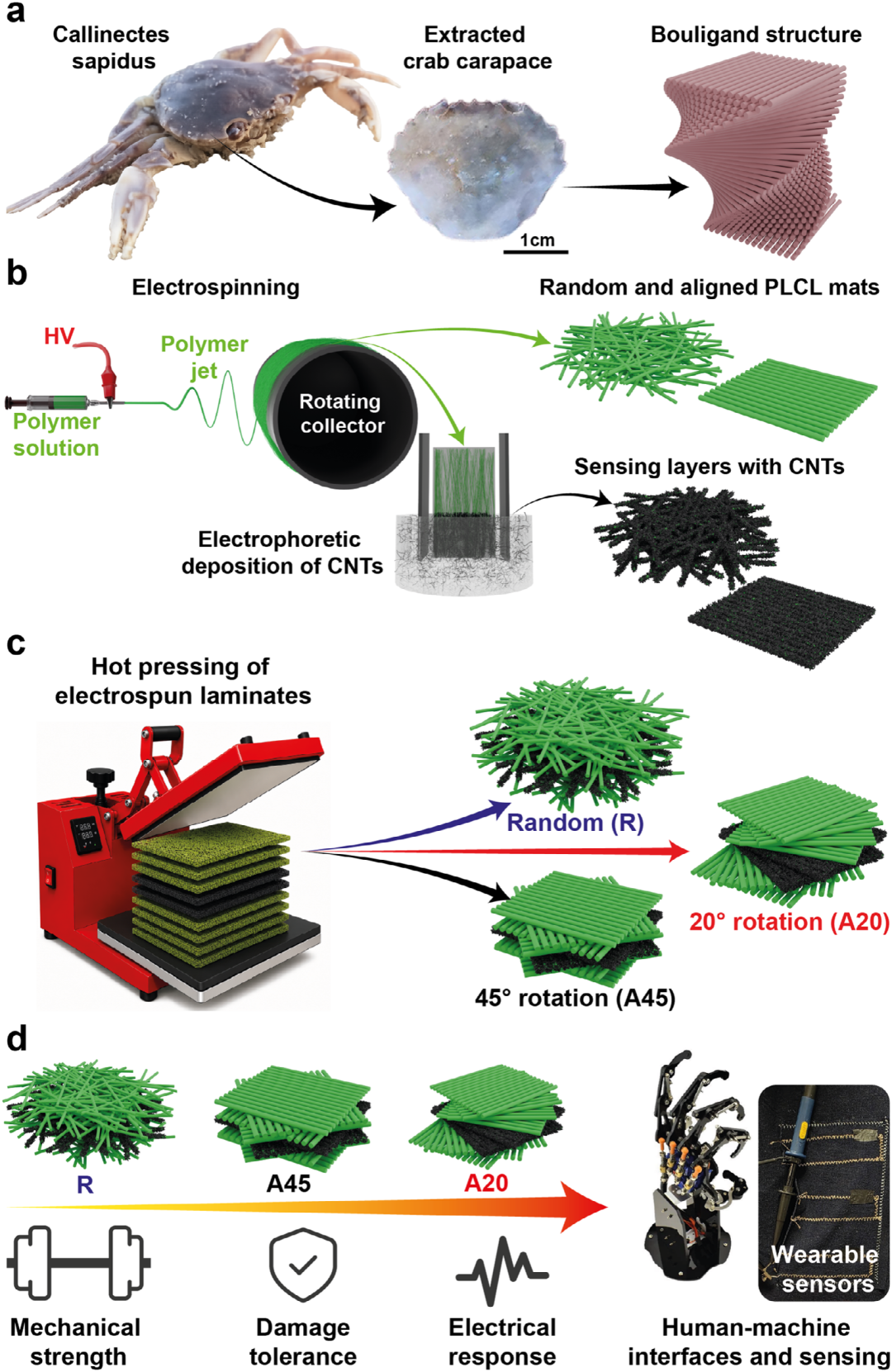
Figure 1
Bioinspired design and fabrication of Bouligand-structured electrospun laminates. a) The exoskeleton of the blue crab (Callinectes sapidus) serves as the biological inspiration for the laminate architecture. The excised crab shell indicates the region used for structural analysis. b) Schematic of electrospun random and aligned PLCL fiber mats, followed by electrophoretic deposition (EPD) of carbon nanotubes (CNTs) on selected mats to form conductive sensing layers. c) Schematic of hot-press laminate fabrication using electrospun mats to produce randomly stacked (R) and Bouligand-inspired architectures with fixed layers of consistent fiber alignment at interlayer rotation angles of 20° (A20) and 45° (A45). d) Summary of the investigated laminate structures and their effects on multifunctional performance. Gradual architectural control from random stacking (R) to Bouligand-inspired configurations (A45 and A20) improves the balance of mechanical robustness, damage tolerance and electromechanical response, enabling applications in textile-integrated sensing and wearable human–machine interfaces.
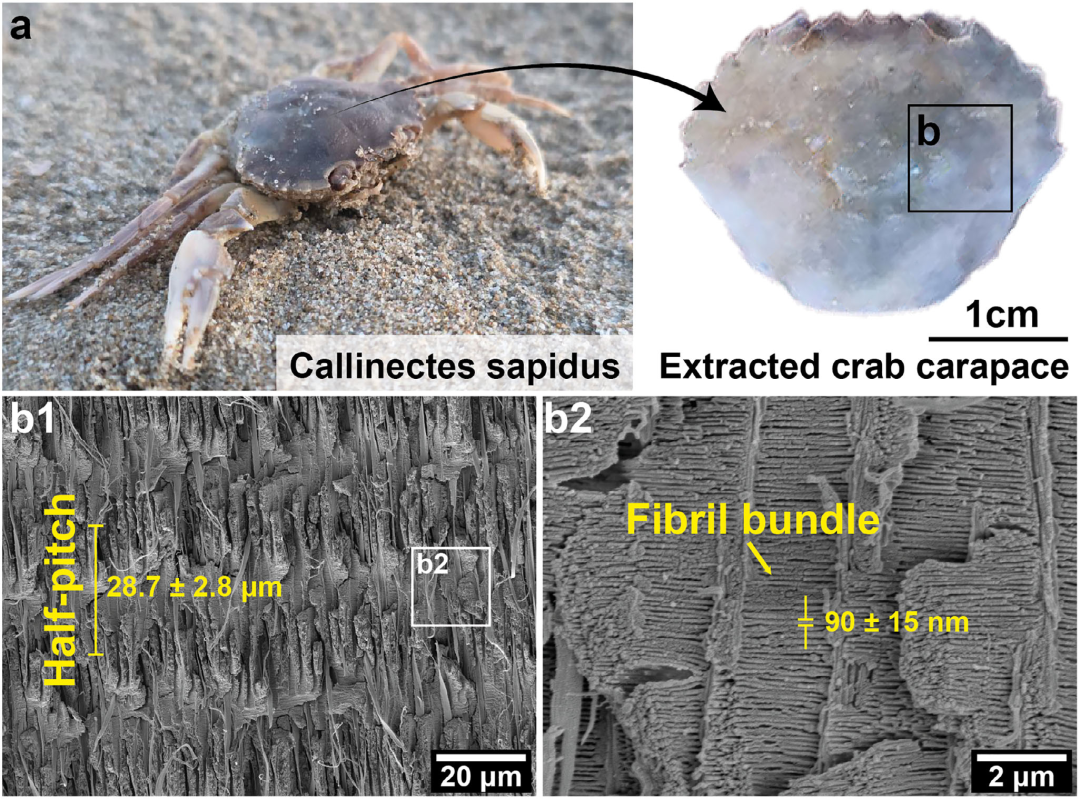
Figure 2
Biological inspiration and quantitative structural analysis of the Bouligand architecture in the blue crab (Callinectes sapidus). a) Photograph of a blue crab and the excised carapace, serving as the biological model for laminate design. b1) Cross-sectional SEM micrograph of crab cuticle, revealing the characteristic Bouligand helical structure. The measured half-pitch (28.7 ± 2.8 µm) corresponds to half of a full fiber rotation across the cuticle thickness. b2) High-magnification SEM image of chitin fiber bundles forming the hierarchical structure.
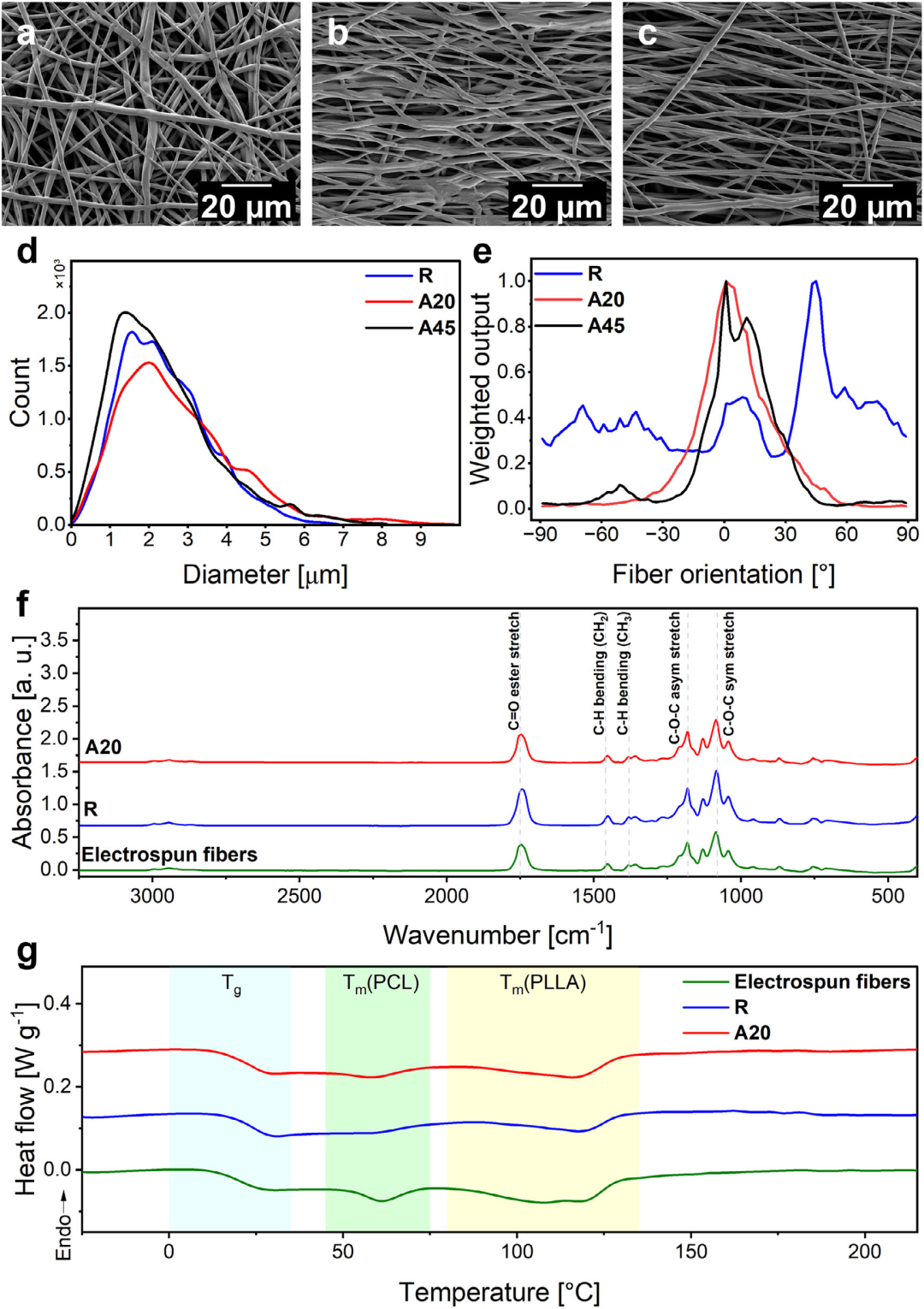 Figure 3
Morphological and physicochemical characterization of Bouligand-inspired electrospun laminates. a–c) Representative SEM micrographs of the laminated R, A20 and A45 PLCL architectures. d) Fiber diameter distributions measured from the laminated structures. e) Quantitative analysis of fiber orientation within the laminates, confirming random and preferentially aligned fiber arrangements. f) FTIR spectra of electrospun reference fibers and representative laminate samples, verifying that the lamination process preserves the chemical structure of PLCL. g) Representative DSC thermograms of electrospun reference fibers as well as R and A20 laminates, showing the glass transition temperature (Tg) and melting transitions of poly(ε‑caprolactone) (PCL) and poly(L‑lactide) (PLLA) crystalline domains.
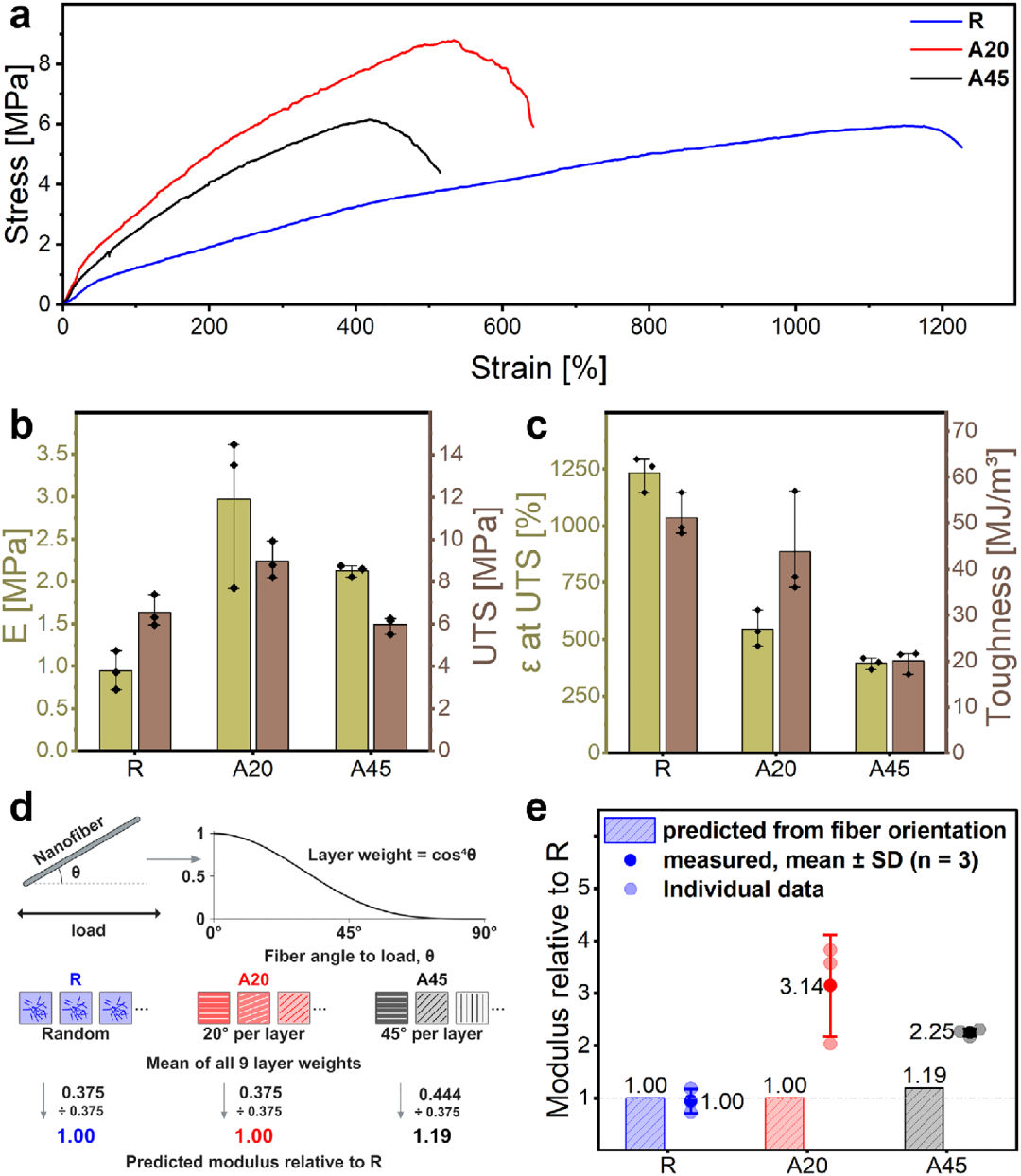
图4
Bouligand启发层压板的机械性能,其中包含嵌入碳纳米管感应层。a)R、A20和A45层压结构的代表性拉伸应力-应变曲线。b)杨氏模量(E)和极限拉伸强度(UTS)。c)UTS的压力(UTS ε)和坚韧。d)用于估算相对杨氏模量的纤维取向模型示意图。方向因素,因为4θ,其中θ是光纤与载荷方向之间的夹角,被平均到九层,并归一化为随机架构(R)。e) 比较预测(阴影条)与测量(填充圆)归一化至R的杨氏模数。实验数据b中,c)和e)以均值±标准差表示,单独测量叠加(n = 3)。
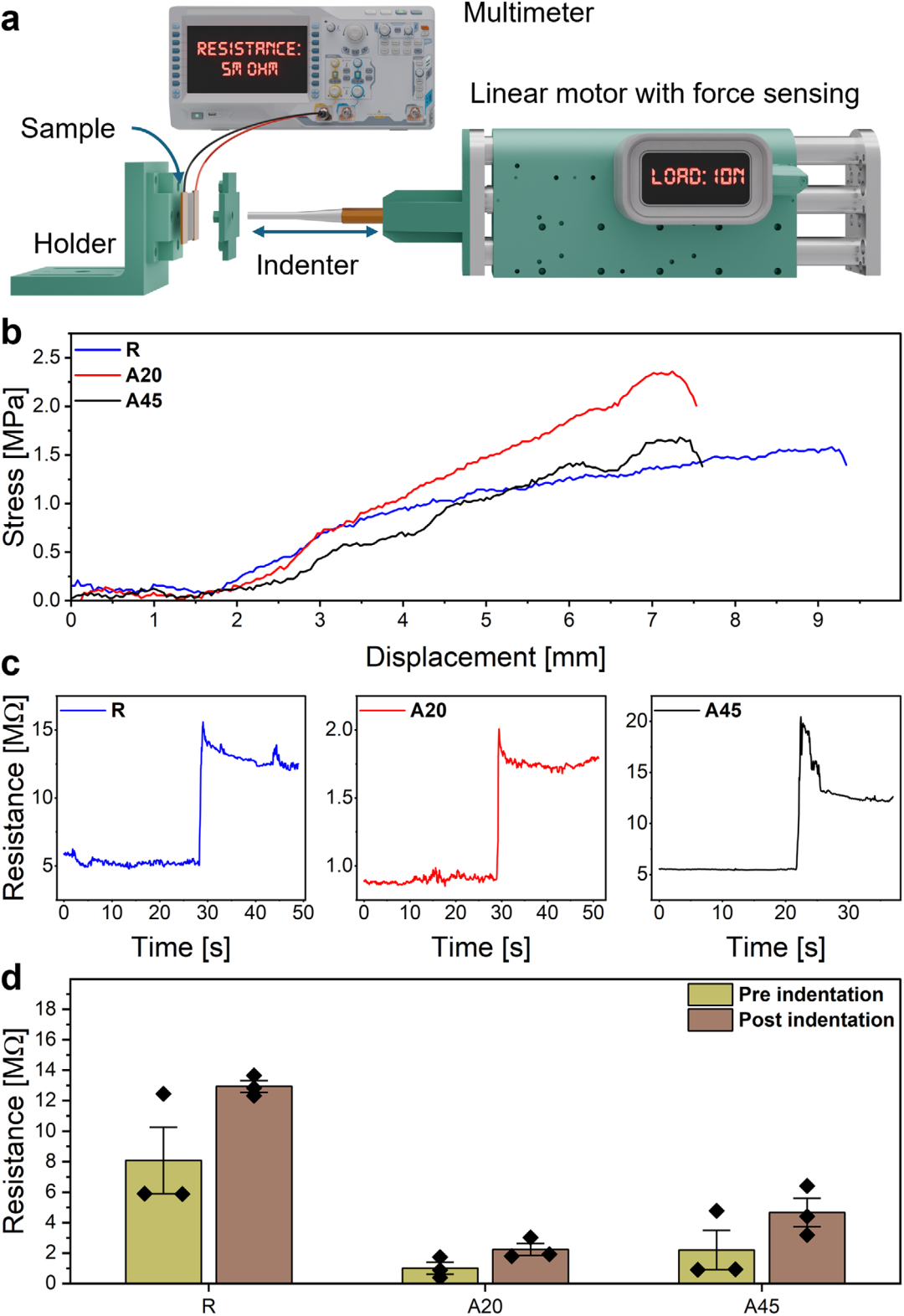
Figure 5
Electromechanical response of Bouligand-inspired laminates. a) Schematic of a custom indentation system integrating simultaneous mechanical loading and in-situ resistance measurement. b) Representative indentation force–displacement curves of R, A20 and A45 laminate architectures. c) Representative resistance profiles recorded during indentation, showing a sharp rise in resistance upon puncture-induced damage to the embedded carbon nanotube (CNT) sensing layer. d) Resistance of the laminates before and after indentation, demonstrating a permanent resistance increase caused by mechanical damage. Data are presented as mean ± standard deviation with individual measurements overlaid.
Summary
Inspired by the helical Bouligand organization of the blue crab exoskeleton, this work translates this stratified architecture into biodegradable electrospun PLCL laminates embedded with CNT sensing layers. While maintaining identical composition, only the interlayer rotation angle of fibers is tuned to isolate the individual effects of laminate structure on mechanical and electromechanical properties. The core strategy lies in bioinspired lamination, angle modulation and integrated sensing.
A 20° interlayer rotation yields the best-balanced mechanical performance: the modulus is enhanced by more than threefold, and the tensile strength rises by nearly 40% compared with randomly stacked laminates. The thin sheet (~100 µm) tolerates out-of-plane deformation of 55–73 times its thickness before failure, and the CNT network enables real-time damage reporting. After textile integration, the laminates serve as sensors for touch, strain, temperature and weight, with electrical output varying by over an order of magnitude. Proof-of-concept testing achieves real-time signal visualization and synchronized robotic hand manipulation.
References:
DOI:10.1002/adfm.79347
We specialize in custom nano-medical functional materials. We conduct targeted development to tailor structure, particle size and surface modification for your experiments. Full characterization, iterative optimization and technical support are available for targeted delivery, bioimaging and nanomedicine studies. Send your evaluation plans to us.
Engineer Zhang: 17715390137
Engineer Chen: 18914047343