已传文件:photo/1794966754.png

 Abstract
This study constructs an ultrasound-responsive electroactive PEEK scaffold, on which MXene@BaTiO₃ piezoelectric heterojunctions are anchored onto a three-dimensional microstructured surface fabricated by femtosecond laser etching. Ultrasound is applied to trigger localized electrical signals to intervene in the aberrant opening of mitochondrial permeability transition pores in senescent bone marrow mesenchymal stem cells (BMSCs). This design adopts spatial isolation to prevent intracellularly internalized single-phase BaTiO₃ from inducing lysosomal oxidative damage. The piezoelectric signals sustain mitochondrial membrane potential, reduce the leakage of mtDNA and cytochrome c, restore energy metabolism linked to oxidative phosphorylation, and thereby promote osteogenic differentiation of senescent BMSCs and the repair of aged bone defects.
01
Research Background
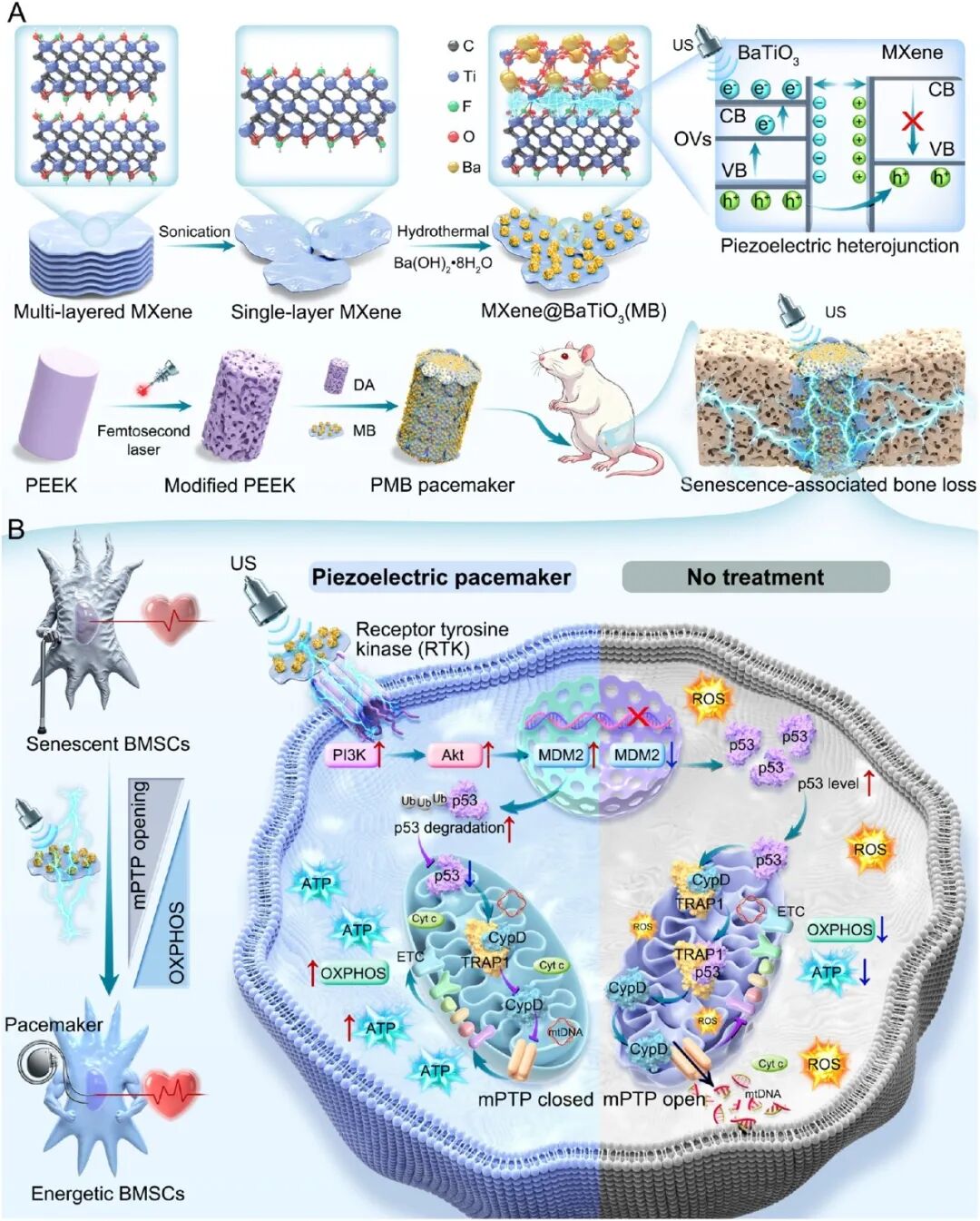
One of the core cytological bases of senescence-associated bone loss is the impaired osteogenic capacity of BMSCs, which is tightly associated with mitochondrial dysfunction and disturbed energy metabolism. Senescent BMSCs exhibit reduced oxidative phosphorylation, decreased membrane potential and insufficient ATP supply. Aberrant opening of mPTP further exacerbates mitochondrial damage and the release of pro-apoptotic factors. Current small-molecule regulatory strategies suffer from limitations in targeting specificity and biosafety. Physical electrical stimulation features non-invasiveness and spatiotemporal controllability, yet conventional electrical stimulation relies on external equipment. Piezoelectric materials can convert ultrasound into localized electrical signals, offering a new strategy for intervening in mitochondrial energy metabolism.
02 Main Content
In this study, PEEK was used as the substrate. A biomimetic three-dimensional microstructure was fabricated via femtosecond laser processing, followed by loading MXene@BaTiO₃ heterojunctions to construct the PMB scaffold. A built-in electric field forms between the MXene conductive network and BaTiO₃, which enhances piezoelectric carrier separation and ultrasound-to-electricity conversion efficiency. The large-sized heterojunctions reduce cellular uptake and avoid reactive oxygen species generation from single-phase BaTiO₃ within lysosomes. Upon ultrasound activation, localized electrical signals suppress excessive mPTP opening and reduce the leakage of mitochondrial contents. Meanwhile, the PI3K/Akt/MDM2 axis is activated to promote p53 degradation, restore TRAP1‑CypD gating, and remodel mitochondrial homeostasis and osteogenic energy metabolism.
03 Study Design
The morphology, crystal phase, chemical state, piezoelectric response, impedance and charge transfer of the heterojunctions were characterized. Density functional theory (DFT) and finite element analysis were adopted to investigate the interfacial electric field. A H₂O₂‑induced senescent BMSC model was established. Under ultrasound stimulation, senescence markers, senescence-associated secretory phenotype (SASP), osteogenic differentiation, mitochondrial morphology, membrane potential, reactive oxygen species (ROS), ATP, mPTP opening and mtDNA/Cyt c leakage were evaluated. Metabolomics, Seahorse analysis, transcriptomics, Western blot, Co‑IP, molecular docking and molecular dynamics simulations were used to dissect the PI3K/Akt/MDM2/p53 and TRAP1‑CypD axes. Pharmacological interventions with Nutlin‑3, LY294002 and other inhibitors were performed for validation. In vivo, an adriamycin‑induced aged rat femoral defect model was built to assess new bone formation, trabecular architecture and mechanistic markers.
04 Results
The PMB heterojunctions exhibit stable piezoelectric output and high electromechanical conversion efficiency, capable of generating localized electrical signals under ultrasound. Compared with single-phase BaTiO₃, the heterojunctions mitigate endocytosis-related oxidative damage. After treatment with PMB plus ultrasound, senescence markers and SASP are downregulated in senescent BMSCs, while osteogenic markers, ALP activity and mineralization are enhanced, accompanied by improved cell spreading. For mitochondria, restored membrane potential, reduced ROS, inhibited aberrant mPTP opening, decreased mtDNA and Cyt c leakage, and improved mitochondrial ultrastructure are observed. Metabolic analyses demonstrate reinforced TCA cycle and oxidative phosphorylation (OXPHOS), shifting energy preference from glycolysis toward oxidative phosphorylation. Mechanistically, electrical signals activate PI3K/Akt/MDM2 to facilitate p53 degradation, weaken p53‑TRAP1 binding and strengthen TRAP1‑CypD interaction, thereby sustaining mPTP closure. In vivo, PMB combined with ultrasound promotes the regeneration of new bone and trabecular structure within defects, with elevated PI3K signaling, decreased p53/p21 and enhanced TRAP1‑CypD colocalization in tissues.
05 Outlook
This work reveals that piezoelectric electrical signals link mitochondrial quality control to osteogenic energy metabolism via mPTP gating. Further investigations are required to clarify the dose‑response relationships among ultrasound parameters, local electric field intensity and intracellular signaling, resolve the structural basis and dynamic regulation of competitive p53‑TRAP1‑CypD binding, and verify the causal relationship between mPTP gating and metabolic reprogramming. In addition, long-term material stability, degradation and in vivo fate, safe ultrasound windows, senescent cell heterogeneity, and the robustness of this strategy across different bone defect models need to be evaluated.
Source Information
ACS Nano
Publication Date: November 12, 2026
DOI: 10.1021/acsnano.6c13460
Meihua Zhang, Lingzhu Yu, Yangrui Chen, Mengmeng Ming, Bin Luo, Yao Wu