已传文件:photo/1795226689.png
Abstract
Osteoarthritis is characterized by articular cartilage degeneration, metabolic imbalance and pain. Current therapies mostly relieve symptoms and cannot reverse cartilage damage. In this study, glutamine-modified ionizable lipid nanoparticles (GLNPs) were engineered for intra-articular delivery of FGF18 mRNA. GLNPs exhibit uniform particle size, efficient encapsulation and RNA protection capacity, facilitating lysosomal escape, cartilage matrix penetration and chondrocyte uptake. In vitro, GLNP-FGF18 upregulates anabolic markers while suppressing catabolic and senescence markers, and released glutamine contributes to synergistic metabolic regulation. Both early and delayed interventions in DMM mice improve gait parameters, mitigate cartilage degeneration and synovitis, reduce osteophyte formation and preserve cartilage matrix. The underlying mechanism is associated with PRG4 upregulation, PI3K-Akt-mTOR modulation and autophagy restoration.
01 Research Background
Osteoarthritis imposes a substantial global burden. Articular cartilage is avascular with limited intrinsic repair capacity, and available treatments primarily relieve pain rather than halt degenerative progression. FGF18 promotes chondrocyte proliferation, enhances anabolism and attenuates degeneration. Nevertheless, recombinant FGF18 protein suffers from rapid intra-articular clearance, poor enzymatic stability and high costs associated with repeated administration. mRNA enables intracellular production of target proteins, yet naked mRNA is vulnerable to nuclease degradation. Moreover, intra-articular clearance and the dense, negatively charged cartilage extracellular matrix hinder the delivery of macromolecules. Ionizable lipid nanoparticles can penetrate the cartilage extracellular matrix via electrostatic interactions and improve chondrocyte affinity. Glutamine not only alleviates cartilage degeneration but also boosts transfection efficiency. Accordingly, we designed glutamine-modified lipid nanoparticles to achieve synergistic FGF18 mRNA delivery and metabolic regulation.
02 Main Content
A novel ionizable lipid was synthesized, and cholesterol-glutamine functional ligands were prepared. GLNPs were formed via co-assembly of the ionizable lipid with mRNA. Formulations were screened by tuning the cholesterol ratio and RNA/lipid ratio. Characterizations including particle size, zeta potential, encapsulation efficiency, colloidal stability, lysosomal escape and glutamine release were performed. In vitro, GLNPs were compared with glutamine-free LNPs in terms of chondrocyte uptake, transfection and cartilage penetration. An IL-1β-induced inflammatory model was used to evaluate anabolism/catabolism, cell proliferation, senescence and pellet matrix secretion. Furthermore, early and delayed intra-articular administrations were compared in the DMM model. Gait analysis, imaging, histology, immunohistochemistry and molecular assays were combined to assess therapeutic efficacy and underlying mechanisms, while major organs and serum parameters were examined for biosafety.
03 Study Design
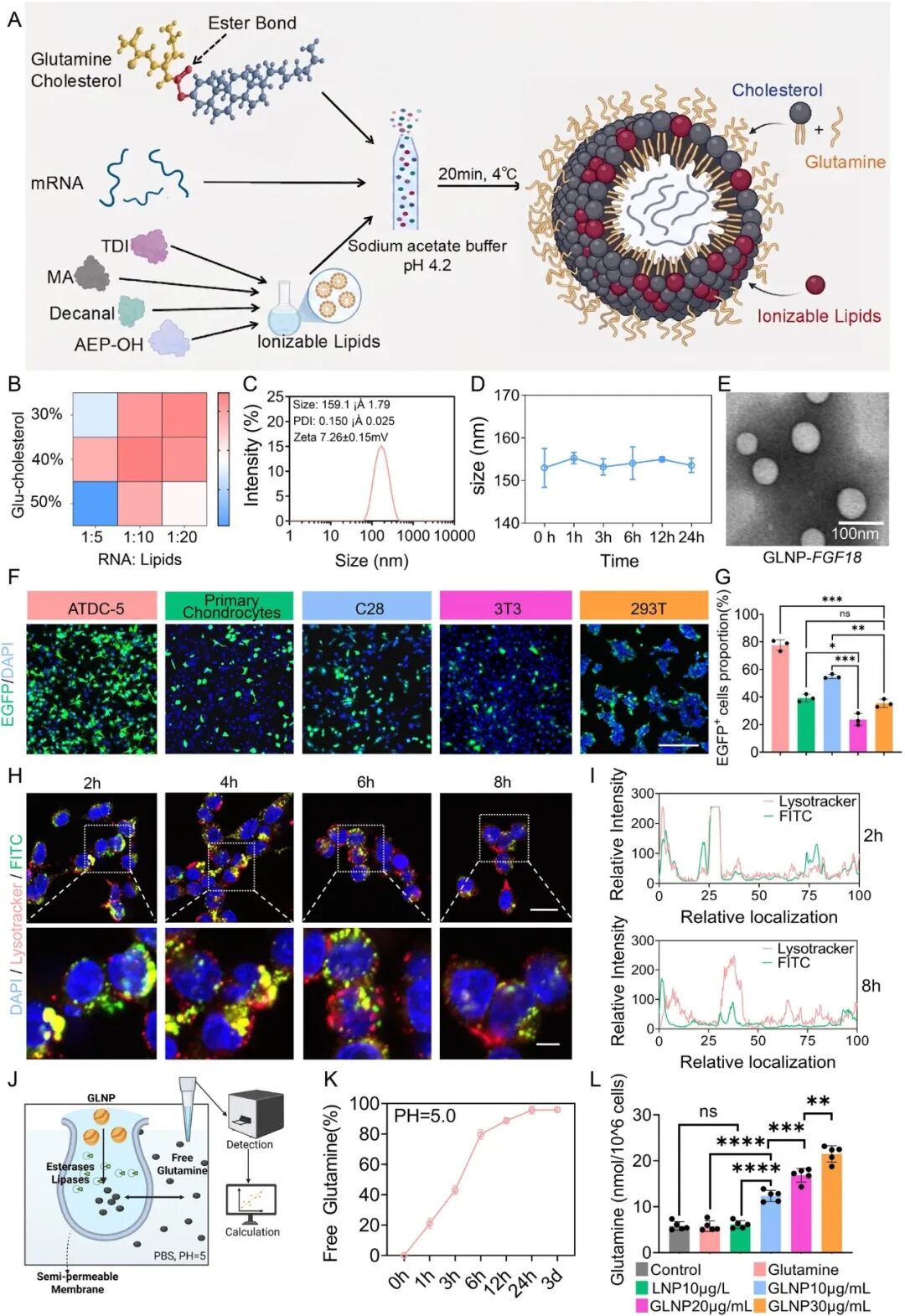
The ionizable lipid was synthesized via a four-component reaction and conjugated with cholesterol-glutamine. GLNPs were fabricated by microfluidic or vortex-assisted assembly. Formulation screening and transfection evaluation were carried out using fluorescent RNA and reporter mRNA. Lysosomal escape was visualized by confocal microscopy; stability was assessed in synovial fluid-mimicking medium; cartilage penetration was tested on human cartilage explants; and chondrocyte uptake was quantified by flow cytometry. In vitro experiments adopted the IL-1β-stimulated chondrocyte model, integrated with RNA sequencing, western blotting, qPCR, immunofluorescence, transmission electron microscopy, autophagy blockade with chloroquine, PRG4 knockdown, and Piezo1 activation/inhibition interventions. The DMM mouse model was applied with early and delayed treatment regimens. Evaluations included gait analysis, micro-CT, H&E staining, safranin O/fast green staining, alcian blue/toluidine blue staining, immunohistochemistry, serum biochemistry and organ histology.
04 Results
GLNPs exhibited uniform particle size, positive surface charge, satisfactory encapsulation efficiency and good colloidal stability. Sustained glutamine release was triggered under acidic/esterase-rich conditions, elevating intracellular glutamine levels. Compared with glutamine-free LNPs, GLNPs achieved higher chondrocyte uptake, deeper cartilage penetration and prolonged transgene expression. In vitro, GLNP-FGF18 upregulated COL2A1, SOX9 and ACAN, suppressed MMP13 and ADAMTS5, increased Ki67/EdU-positive proliferative cells, reduced p16, p21 and SA-β-Gal signals, and restored pellet matrix secretion, with superior performance relative to LNP-FGF18. Mechanistically, GLNP-FGF18 upregulated PRG4, modulated the PI3K-Akt-mTOR pathway and restored autophagy. PRG4 knockdown partially abrogated the protective effects, and autophagy inhibition by chloroquine weakened the therapeutic benefits. Both early and delayed interventions in DMM mice improved gait performance, reduced osteophyte formation, alleviated synovitis and lowered OARSI scores, preserved cartilage matrix and boosted FGF18 expression. No obvious abnormalities were observed in serum biochemistry or major organs.
05 Outlook
This study highlights that intra-articular mRNA delivery for osteoarthritis needs to simultaneously address cartilage matrix penetration, cellular internalization and metabolic support, wherein glutamine functions both as a targeting ligand and a metabolic regulator. Future work will directly monitor the dynamics of FGF18 expression after each administration and its correlation with cumulative dosage and tissue remodeling. The causal contributions of glutamine transporters, GFPT1 and the PRG4 axis will be clarified. The crosstalk between Piezo1/calcium signaling and autophagy restoration will be dissected. Validation will be performed in models that better recapitulate human cartilage thickness, mechanical loading and different OA stages. Long-term safety, material biodistribution and clearance upon repeated dosing will be evaluated. Meanwhile, formulation stability, batch-to-batch consistency and administration schedules will be further optimized.
Source:
Advanced Functional Materials
Pub Date: 2026-11-04
DOI: 10.1002/adfm.79448
Yucan Ju, Liming He, Qiang Huang, Maling Gou, Zeyu Huang
We specialize in custom fabrication of functional nanomaterials for nanomedicine. According to your experimental requirements, we can tailor biofunctional nanomaterials with controllable structure, particle size and surface modification, along with a full set of characterization services. Flexible optimization of research schemes and continuous technical support are available to support research projects involving targeted delivery, bioimaging, nanotheranostics and other related fields. Feel free to share your specification requirements, and we will evaluate and propose a customized solution.
Mr. Zhang: +86 17715390137
Mr. Chen: +86 18914047343