

 Nanomedicine
Frontiers of Medical Engineering|Nature Big News! Natural Chiral Superlattices Master Topological Magnetism|Chiral Superlattices Achieve Spin-Split Topological Antiferromagnetism
QQ Academic Group: 1092348845
Detailed
 Chirality has emerged as a new mechanism to induce spin and Berry curvature phenomena in quantum materials and molecular chemistry. Collinear antiferromagnets (AFMs) hold great promise in spintronics and topological magnetism, yet it remains challenging to achieve large Berry curvature and spin-split bands. Here we report a chiral-superlattice route to realize spin-split topological phenomena via collinear antiferromagnetism. We investigate a family of collinear AFM microcrystals that exhibit spontaneous chiral superlattices arising from frozen chiral phonons at finite wavevectors. Without the superlattice, the pristine collinear AFM in UOTe features neither Berry curvature nor spin-split bands. As electrons traverse the chiral superlattice, their orbital Bloch wavefunctions and quantum geometry are strongly modulated by the chiral superlattice potential, giving rise to substantial Berry curvature, which we detect via the nonlinear Hall effect. At 150 K, the chiral-superlattice-induced Berry curvature couples with the collinear AFM order, leading to an abrupt anomalous Hall angle of ~0.14 near the Néel temperature (T_N), which is among the largest values reported for bulk magnets. Furthermore, our spin Hanle precession measurements demonstrate that the chiral superlattice can also generate spin-polarized currents from collinear AFMs, a long-sought goal in spintronics. We elucidate the supermodulation formation mechanism based on chemical ion size and the competition between interlayer and intralayer physical energies, and accordingly propose design principles for discovering analogous bond-mismatched superlattices that offer chiral-superlattice pathways through real-space engineering of quantum geometry.
This study was published in Nature under the title “A chiral superlattice route to spin-split topological antiferromagnetism”.
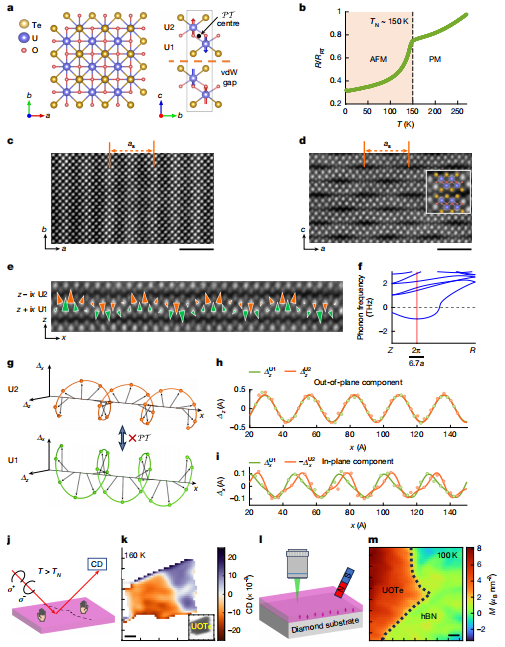
Figure 1
a, Crystal structure and collinear AFM of UOTe. b, Resistance of a UOTe flake (13.3 nm) showing metallic temperature dependence. c, d, Plan-view and cross-sectional images of UOTe. A spontaneous superlattice with an in-plane period (sapprox 6.7a) is observed. e, Cross-sectional STEM image of a stack of UOTe vdW layers. Arrows denote the displacements of U1 and U2. f, Magnified view showing the phonon dispersion of UOTe calculated by DFT. See Extended Data Fig. 2 for the full dispersion. The negative phonon frequency at finite wavevector q matches the experimentally observed q of the superlattice. g, Schematic illustration of U1 and U2 atomic displacements with opposite chiral winding configurations. The amplitudes of the opposite winding structures differ slightly, so they do not cancel each other out.
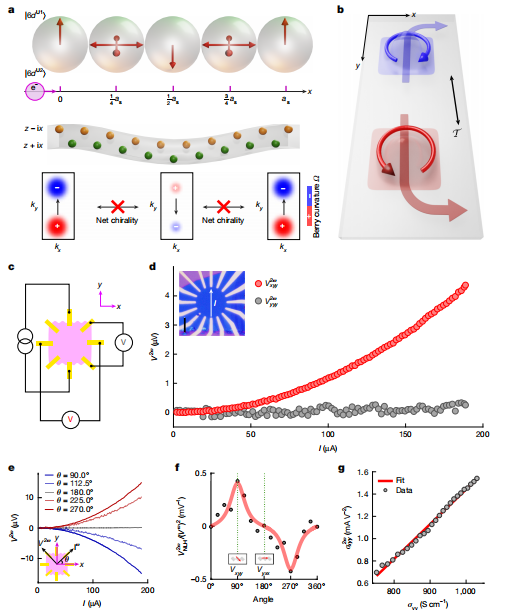
Figure 2
a, The conducting electrons derived from the U 6d orbitals can be described by a two-component wavefunction. As the conducting electrons travel through the superlattice, both the Bloch wavefunctions and Berry curvature dipoles undergo spatial modulation (see main text). b, The net Berry curvature dipole along (k_y) can be detected via the nonlinear Hall effect, where the injected current is along the y direction and the resulting Hall voltage develops along the x direction. c, Schematic of the measurement setup. d, Nonlinear transport measurement of UOTe at (T=250) K. Inset shows an optical image of the UOTe device. e,f, Angle-dependent nonlinear Hall measurements at (T=250) K. The direction of the injected current and the nonlinear Hall voltage (V_{ m 2omega}) are rotated simultaneously with respect to the crystal axes. The angle-dependent measurement reveals a large nonlinear Hall signal when the injected current is aligned along the y direction, demonstrating the directional Berry curvature dipole along (k_y). g, Nonlinear Hall conductivity normalized by the Drude conductivity obtained from temperature-dependent measurements between 200 K and 300 K. Scale bar, 10 μm (inset in d).
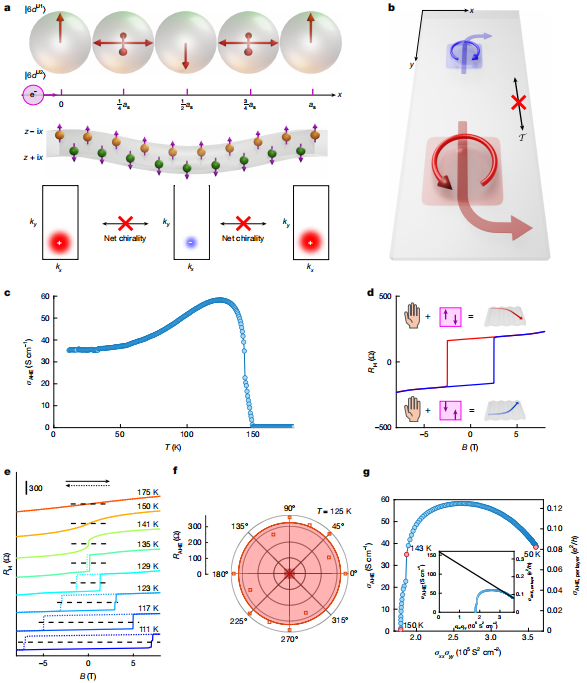
Figure 3
a, The collinear AFM order can break the cancellation of opposite Berry curvatures at (pm k_y): (x=0) and (x=a_s/2) possess opposite total Berry curvatures, which do not cancel owing to the net chirality. b, Net Berry curvature in k-space gives rise to the AHE. c, Temperature dependence of the AHE conductivity. d, Magnetic-field dependence of the Hall resistivity at 125 K, showing a clear anomalous Hall hysteresis loop. e, Temperature evolution of the AHE, revealing a coercive magnetic field up to 8 T near 110 K. f, Angle dependence of the anomalous Hall resistance at 125 K. g, Scaling behaviour of the AHE signal.
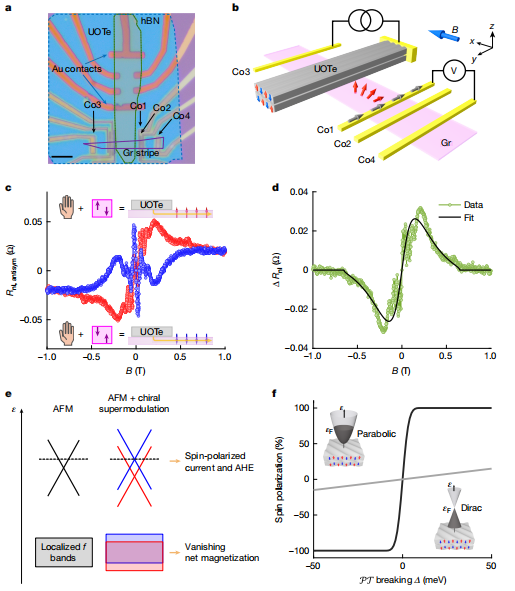
Figure 4
a,b, Schematic and optical image of the nonlocal spin-transport device, consisting of a UOTe flake as the spin injector, Al₂O₃/Co contacts as the spin detector, and a monolayer graphene channel for spin transport. The thickness of the UOTe flake is 27 nm. c, In-plane magnetic-field dependence of the nonlocal resistance measured after initializing UOTe into AFM I and AFM II states at 1.7 K, while the magnetization of the Co detector remains fixed. d, Hanle signal curve fitted to the solution of the Bloch equation for a homogeneous spin-diffusion system (see main text for details). e, A small chiral imbalance implies a small net magnetization. Moreover, the relevant U 5f-derived bands in UOTe lie below the Fermi level and do not contribute to the Fermi surface. The Fermi-level electrons form small pockets, which naturally contribute little to the net magnetization. In contrast, the spin-polarized current is determined solely by the spin polarization at the Fermi surface. UOTe hosts spin-split semimetallic bands near the Fermi level, yielding intrinsically large spin polarization of the current. f, Model calculation of the current spin polarization as a function of symmetry breaking Δ. Scale bar, 10 μm (a).
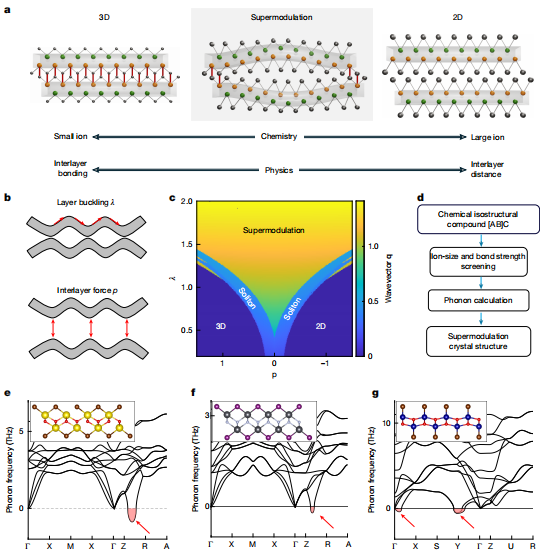
Figure 5
a, Chiral supermodulation represents an intermediate phase between the three-dimensional covalent phase and the two-dimensional van der Waals (vdW) phase, arising from the competition between interlayer bonding and intralayer repulsive energies, which can be tuned via chemical ion sizes. b, Schematic illustration of layer buckling (lambda) and interlayer force p emerging in the free energy. c, Phase diagram as a function of (lambda) and p, showing supermodulation as the intermediate phase between the 3D covalent phase and the 2D vdW phase. An additional exotic soliton-supercrystal phase exists at the boundaries between the supermodulated phase and the 2D/3D phases (see Supplementary Information Section II.1). d, Flowchart for discovering analogous chiral supermodulation in other materials. e–g, DFT-calculated phonon dispersions showing similar instabilities in other materials (PrOBr (e), PbFI (f), CrOBr (g)).
Summary
Starting from a family of collinear antiferromagnetic microcrystals, this work realizes spontaneous chiral superlattices formed by frozen chiral phonons at finite wavevectors. Taking UOTe as a benchmark, the pristine collinear antiferromagnet exhibits neither Berry curvature nor spin-split bands. When electrons travel through the chiral superlattice, their orbital Bloch wavefunctions and quantum geometry are strongly modulated, generating large Berry curvature that is detected via the nonlinear Hall effect. This Berry curvature couples with the antiferromagnetic order, giving rise to an anomalous Hall angle of approximately 0.14 near the Néel temperature at 150 K. Spin Hanle precession measurements further demonstrate the capability to produce spin-polarized current.
For extension, the formation of the superlattice is attributed to the competition between chemical ion size and interlayer–intralayer energies. On this basis, design principles for bond-mismatched superlattices are proposed. This strategy enables real-space engineering of quantum geometry, converting collinear antiferromagnets into chiral superlattice platforms with spin-split topological responses. It provides a feasible route to explore analogous systems, probe nonlinear Hall signals and spin-polarized currents, and guides the design of new materials for spintronics and topological magnetism.
Reference:
DOI:10.1038/s41586-026-11073-7
We specialize in custom nano-medical functional materials. We conduct targeted development to tailor structure, particle size and surface modification for your experiments. Full characterization, iterative optimization and technical support are available for targeted delivery, bioimaging and nanomedicine studies. Send your evaluation plans to us.
Engineer Zhang: 17715390137
Engineer Chen: 18914047343
- Previous: Journal of Extracellul
- Next: 没有了...


