已传文件:photo/1766544328.png
Article Highlights
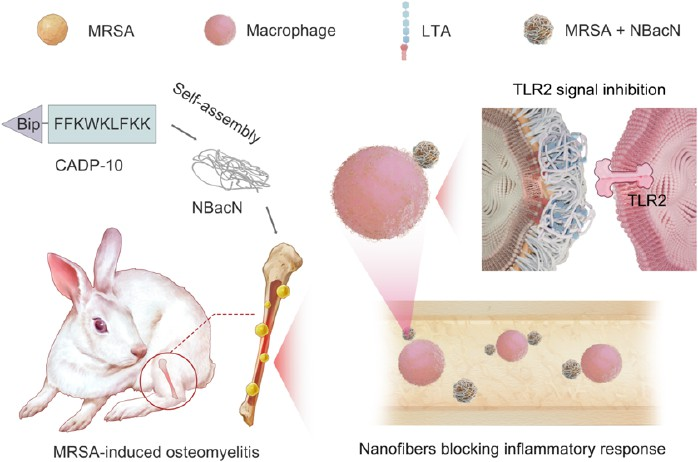
Osteomyelitis presents a significant treatment challenge due to the widespread occurrence of multidrug-resistant bacterial infections and associated inflammation. Current treatment approaches typically rely on a combination of corticosteroids and antibiotics, which may lead to complications and hinder effective bacterial clearance.In this study, we proposed CADP-10, a peptide derived from silkworm chitinase A, designed to target methicillin-resistant Staphylococcus aureus (MRSA) and multidrug-resistant Escherichia coli (MRE), while also addressing inflammatory responses.CADP-10 self-assembles into a nanobacterial network (NBacN), selectively recognizing and binding bacterial endotoxins (LPS and LTA), disrupting membrane integrity and depolarizing membrane potential, ultimately leading to bacterial death. Importantly, these NBacNs bind to LPS and LTA from dead bacteria, preventing them from interacting with TLR receptors and effectively blocking downstream inflammatory pathways.Our evaluation of CADP-10 indicates that it has good biosafety in both in vitro and in vivo models. Notably, in a rabbit osteomyelitis model, CADP-10 eradicated MRSA-induced bone infection, reduced inflammation, and promoted bone tissue regeneration. This study highlights the potential of CADP-10 as a versatile antimicrobial agent for treating infectious inflammatory diseases.
Idea Extension
1. Based on the mechanism of action of CADP-10, the idea can be extended to the peptide-derived design targeting other Gram-positive or Gram-negative drug-resistant bacteria, and even fungi. By modularly modifying the amino acid sequence of the peptides or regulating the self-assembly environment, nano-networks can be custom-developed to target different pathogen-associated molecular patterns, thereby expanding their antibacterial spectrum and addressing a broader range of infection scenarios.
2. Future research could explore combining CADP-10 with existing clinical approaches, such as integrating it as a local delivery system with biomaterial scaffolds for the treatment of implant-related infections, or using it in conjunction with low-dose antibiotics to produce a synergistic effect, while further functionalizing it to carry growth factors or anti-fibrotic drugs, enabling efficient tissue reconstruction following infection control.
Original link
Cecropin A-Derived Peptide for the Treatment of Osteomyelitis by Inhibiting the Growth of Multidrug-Resistant Bacteria and Eliminating Inflammation
ACS Nano ( IF 16 )
Pub Date : 2025-04-15
DOI: 10.1021/acsnano.4c18858
Ziao Zhou, Peng Zhang, Dinghao Chen, Nan Kong, Huayang Liu, Juan Liang, Kai Huang, Huaimin Wang