已传文件:photo/1766544328.png
Cancer is the second leading cause of death worldwide after cardiovascular diseases, posing a significant threat to public health. The clinical treatment methods for cancer mainly include chemotherapy, surgical therapy, radiotherapy, and immunotherapy, among others. Among them, chemotherapy is one of the main treatment methods for cancer. However, most chemotherapy drugs lack selectivity for tumor tissues, often causing adverse reactions in normal tissues. To address this issue, researchers have developed prodrugs that can be specifically activated by the tumor microenvironment. These prodrugs can respond to the tumor microenvironment (such as pH, reactive oxygen species, hypoxia, enzymes, etc.) and selectively release anti-cancer drugs, thereby achieving specific killing of tumor tissues. Hypoxia is a hallmark feature of solid tumors and is also considered one of the key targets for prodrug activation and the release of anti-cancer drugs. Currently, most hypoxia-activated prodrugs are developed by introducing hypoxia-triggering units into the drug molecules (Figure 1A). However, the heterogeneity of tumor tissues leads to uneven distribution of hypoxia within the tissues, which limits the release of the drugs, and the presence of drug resistance in chemotherapy drugs also limits the therapeutic effect of such prodrugs.
Based on the above research background, Associate Professor Liu Zhaolong from the School of Pharmacy of Qingdao University, Professor Sun Yong, and the research team of Professor Zhang Run from the Institute of Biomedical Engineering and Nanotechnology at the University of Queensland in Australia collaborated to design and develop a self-decomposing cationic iridium(III) complex prodrug, Ir-azo-Cl, which enhances the drug release of the prodrug through the two-photon photodynamic therapy of the iridium(III) complex photosensitizer, achieving potent anti-tumor chemical-photodynamic synergistic therapy. Ir-azo-Cl is formed by connecting the iridium(III) complex photosensitizer with the nitrogen mustard drug through the oxygen-responsive azo bond "-N=N-". In the tumor hypoxic microenvironment, the overexpressed azo reductase (AzoR) efficiently cleaves the azo bond, and Ir-azo-Cl decomposes into the photo-toxic Photo-Ir and the chemotherapy drug Chem-NCl. During this process, the luminescence signal of the iridium(III) complex is activated, enabling real-time monitoring of the drug release. Subsequently, Photo-Ir, through the oxygen-consuming process of two-photon photodynamic therapy (TP-PDT), further promotes the secondary decomposition of Ir-azo-Cl, forming a positive feedback loop, releasing more Photo-Ir and Chem-NCl, thereby enhancing drug release and synergistically improving the anti-tumor effect (Figure 1B). To further enhance tumor targeting and accumulation, Ir-azo-Cl is encapsulated in a phospholipid carrier to form the nano-prodrug DPF@Ir-azo-Cl. In the melanoma tumor-bearing mouse model, DPF@Ir-azo-Cl exhibits excellent tumor enrichment ability and significant anti-tumor efficacy. 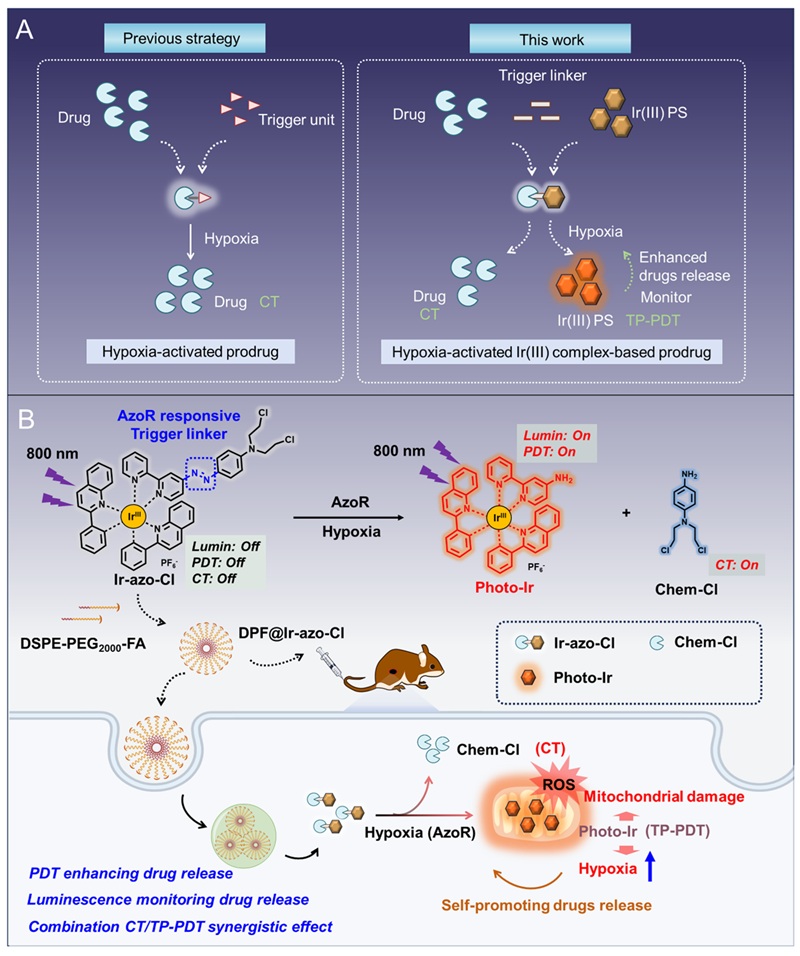
Figure 1. (A) Schematic diagram of the design strategy for hypoxia-activated prodrugs. (B) Structure, activation mechanism of the self-decomposing cationic iridium(III) complex prodrug Ir-azo-Cl, and the schematic diagram of its encapsulation to form the nano-prodrug DPF@Ir-azo-Cl for enhancing the synergistic anti-tumor effect of chemical and photodynamic therapy.
The new strategy of oxygen deprivation-activated prodrug design with enhanced photodynamic drug self-decomposition (Figure 1A) adopted in this study can effectively promote drug release and significantly enhance the synergistic anti-tumor effect of chemical and photodynamic therapies. This achievement was recently published in the international comprehensive chemistry journal Journal of the American Chemical Society.