已传文件:photo/1793327768.png
 Summary:
This review looks at silk fibroin/polylactic acid composite scaffolds as a complementary platform for bone and interface tissue regeneration. Silk provides cell-interaction chemistry, hydrophilicity, and enzymatic degradation, while polylactic acid offers processability, stiffness, and long-term structural support. The article compares preparation methods and connects composition, fiber structure, interface bonding, and degradation to mechanical signaling, bone formation, vascularization, and macrophage response, while also pointing out gaps in evidence and the need for standardization.
01
ResearchBackground
Repair of bone, ligament, tendon and osteochondral defects remains challenging, as existing grafts hardly satisfy mechanical, biological and degradation matching requirements simultaneously. Bone tissue engineering demands scaffolds that provide structural support, cell-interactive cues and tunable degradation. Silk fibroin and polylactic acid exhibit complementary properties, yet each suffers from inherent limitations when used alone. Composite design is required to balance structural support and bioactivity at both the interfacial and systemic levels.
02
Main Content
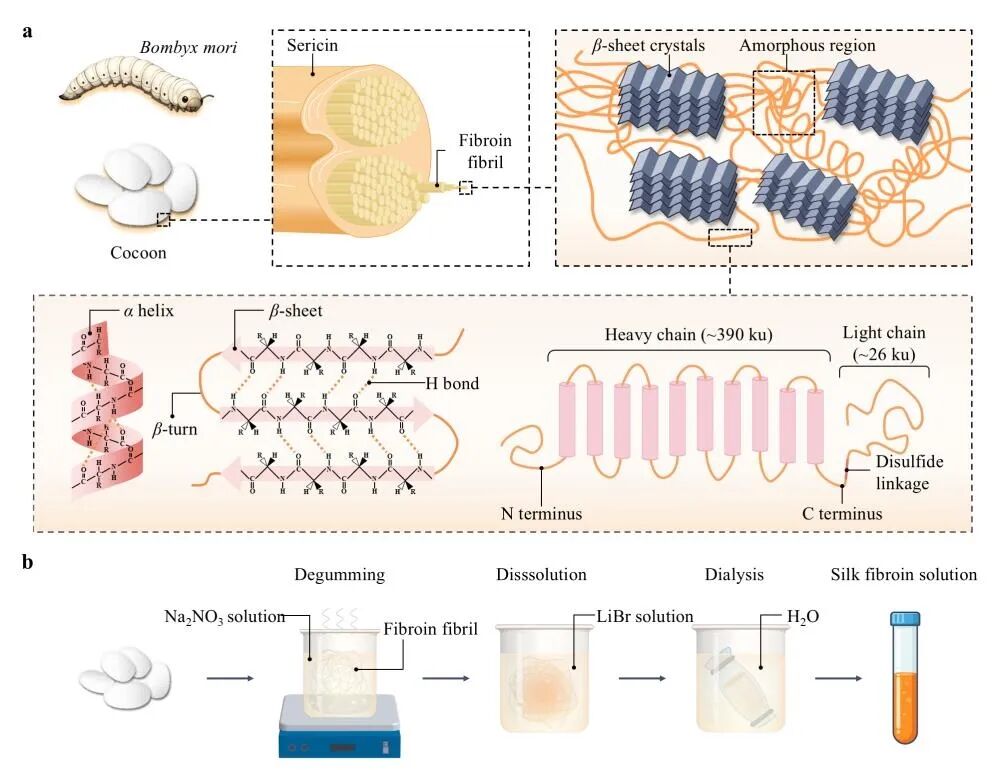
This section provides an overview of the sources, structure, biocompatibility, degradation, mechanical properties, and osteogenic activity of silk, as well as the degradation behavior, mechanical and physical properties, and modification strategies of polylactic acid. It discusses how composite scaffolds balance stiffness and toughness, degradation rate and mechanical integrity, and inertness versus bioactivity. It also summarizes preparation methods like electrospinning, 3D printing, injection/molding, and others, and evaluates their functional performance in repairing load-bearing bones, tendons/ligaments, and osteochondral tissues.
03
Research Design
This is a review-type study. The author integrates materials chemistry, processing methods, scaffold structures, biological mechanisms, and translational evidence to compare different preparation strategies; links composition, fiber structure, interface bonding, and degradation with mechanical signaling, bone formation, angiogenesis, and macrophage responses; distinguishes in vitro descriptive findings, in vivo evidence, and manufacturing and regulatory considerations, emphasizing that enhancing a single cell response isn’t enough to prove it’s ready for application.
04
Results
Silk/PLA composite scaffolds can achieve a synergy of structure, mechanics, and biology. PLA provides stiffness and lasting structure, while silk offers toughness, hydrophilicity, and cell recognition cues; silk degrades enzymatically near neutral pH, which can buffer the acidic products from PLA hydrolysis. Composite scaffolds may affect integrin/FAK/MAPK osteogenic signaling, YAP/TAZ mechanotransduction, and macrophage polarization from M1 to M2. Different fabrication methods can produce nanofibers, patient-specific macroporous structures, or scalable bulk composites, but most evidence is still from in vitro studies and small animals, with insufficient standardized manufacturing and long-term safety evaluation.
05
Future Directions
In the future, we need to prioritize establishing standardized manufacturing and reporting protocols, and carry out mechanical testing, large animal validation, as well as long-term assessments of immunity and degradation that match the target organization. AI can help optimize composition, porosity, fiber orientation, and processing parameters; pH/enzymatic responsiveness, shape memory, and thermosensitive scaffolds can enable on-demand delivery; dynamic microenvironment modulation and immune regulation strategies are worth exploring further. Integrating sensors with closed-loop therapy systems is still in the early stages, and we need to verify their stability, release behavior, biocompatibility, and manufacturing compatibility.
Original Source:
Journal of Bioresources and Bioproducts
Pub Date: 2026-09-23
DOI: 10.1016/j.jobab.2026.100302
Hengda Wang, Zaikai Zhuang, Jingyi Cui, Peng Wang, Meng Zhang, Ke
Zheng, Qiangqiang Li, Caoxing Huang
We focus on customizing functional materials for nanomedicine and can develop them according to experimental needs. We can adjust material structure, particle size, and surface modifications, and provide full characterization support. Our services include iterative optimization, full technical collaboration, and support for research projects in targeted delivery, bioimaging, and nano-therapeutics. You’re welcome to provide your evaluation criteria. Contact: Engineer Zhang 17715390137, Engineer Chen 18914047343