已传文件:photo/1795658271.png
 Abstract:
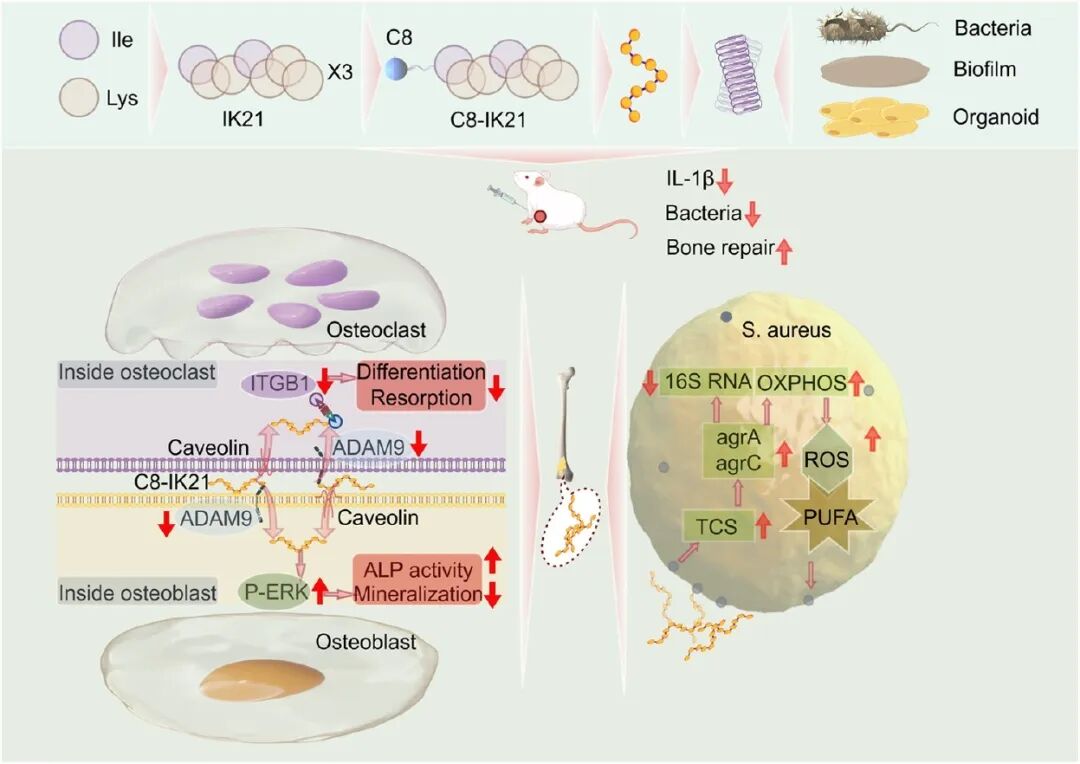
In this study, engineered peptide nanoparticles C8‑IK21 were designed based on a coiled‑coil motif. They can target bacterial membranes and aggravate bacterial death via lipid peroxidation. Local administration at a safe dose achieves both antibacterial and pro‑repair effects in a mouse cortical bone defect model infected with Staphylococcus aureus, and no obvious drug resistance was observed under the experimental conditions. This peptide also exhibits anti‑inflammatory activity. It can bind to ADAM9 for cellular internalization, activate the ERK pathway to regulate osteogenic differentiation, and downregulate ITGB1 expression through ADAM9 to inhibit osteoclast differentiation and function. Its osteogenic effect was further verified in organoids.
01
Research Background
Bone infection is a common severe complication in orthopedics, which can be triggered by trauma, surgery or hematogenous spread. The frequently involved pathogens include Staphylococcus aureus, Staphylococcus epidermidis, Pseudomonas aeruginosa and Escherichia coli. Bacterial colonization leads to biofilm formation, and the acidic, hypoxic microenvironment within biofilms facilitates bacterial virulence and survival. Conventional strategies such as broad‑spectrum antibiotics, debridement, hyperbaric oxygen therapy and local administration are constrained by drug resistance, biofilm barriers and disrupted bone homeostasis. Hence, intervention molecules that can simultaneously reduce bacterial burden and promote bone regeneration are urgently needed.
02 Main Content
C8-IK21 was designed with isoleucine to form hydrophobic stripes and lysine to provide positive charges, and octanoic acid was introduced at the N-terminus to enhance membrane binding. This peptide can self-assemble into nanoparticles and nanofibers and maintain structural stability in a simulated membrane environment. Its functions include disrupting bacterial membranes, altering bacterial metabolism, inhibiting and eradicating biofilms, and alleviating inflammation. On the bone side, it promotes osteogenesis via the ADAM9‑ERK axis and inhibits osteoclastogenesis through the ADAM9‑ITGB1 axis, realizing a dual-functional design for antibacterial action and bone homeostasis regulation.
03 Study Design
Minimum inhibitory concentration (MIC) and minimum bactericidal concentration (MBC) assays were performed. Stability under physiological ionic conditions, time-kill curves, live/dead staining, drug resistance induction, and combined drug susceptibility with vancomycin were evaluated. Crystal violet staining, live/dead staining and scanning electron microscopy were used to assess biofilm inhibition and eradication. Osteogenic differentiation, inflammatory responses and ADAM9-related signaling were examined at the cellular and organoid levels. A mouse infected cortical bone defect model of the femur was established. After local administration, bacterial burden, inflammation and bone repair were evaluated, together with mechanistic validation of osteogenic and osteoclastogenic regulation.
04 Results
C8-IK21 exhibits antibacterial activity against both Gram-positive and Gram-negative bacteria, with stable activity under ionic conditions. It rapidly disrupts bacterial membranes, suppresses biofilm formation and eliminates mature biofilms. No obvious spontaneous drug resistance was observed under experimental conditions, and a synergistic tendency was shown when combined with vancomycin. This peptide attenuates inflammatory responses, upregulates osteogenic markers and mineralization, while inhibiting osteoclast differentiation and function. Mechanistically, it binds to ADAM9 to activate ERK for osteogenesis and downregulates ITGB1 to suppress osteoclastogenesis. Local administration in the infected bone defect model reduces bacterial burden, relieves inflammation and facilitates bone repair.
05 Outlook
This study demonstrates that engineered peptide nanoparticles can integrate membrane-targeted bactericidal effects, anti-biofilm activity, anti-inflammation and bone homeostasis regulation into a single molecule. Further investigations are needed to clarify its membrane selectivity, the relative contributions of lipid peroxidation and metabolic disturbance, and to dissect the cell specificity of the ADAM9‑ERK and ADAM9‑ITGB1 pathways, as well as their crosstalk with immune cells and the biofilm microenvironment. It is also necessary to evaluate its robustness against different bacterial species, drug-resistant strains and complex infection models, optimize administration routes, local retention and long-term safety, and improve preparation processes and quality control systems.
Source:
ACS Nano
Pub
Date: 2026-11-11
DOI: 10.1021/acsnano.6c16565
Yimeng Lu, Ti Zhang, Xiabing Han, Yaqi Cui, Dan He, Ming Yan, Xiaozhu Wang, Cheng Wang, Feng Li, Hongshan Zhao
We focus on custom fabrication of functional nanomedicine materials. We can carry out targeted development according to experimental requirements, tune material structure, particle size and surface modification, and provide a full set of characterization services. Solutions are available for repeated optimization with continuous technical support. Our services cover targeted delivery, bioimaging, nanotheranostics and other research projects. Welcome to send your specifications for solution evaluation.
Mr. Zhang: 17715390137
Mr. Chen: 18914047343