已传文件:photo/1793672303.png
 Abstract:
In this study, we constructed a siP@WM nanomedicine with a platinum nanozyme core and a mesoporous silica shell loaded with IRF5 siRNA to achieve programmed sequential targeting of bone tissue and M1 macrophages. Long chains modified with PASP facilitate bone accumulation. Cleavage of the ROS-responsive TK linker shortens the outer chains and exposes folate moieties to enhance uptake by M1 macrophages. This system scavenges ROS and silences IRF5, promotes macrophage polarization toward the M2 phenotype, and inhibits osteoclastogenic signaling. Systemic administration in ovariectomized mice ameliorates bone loss, trabecular microstructure and mechanical properties. Transcriptomic and histological analyses reveal attenuated AP‑1‑related inflammatory signaling, suppressed osteoclast differentiation and altered extracellular matrix remodeling, with no obvious toxicity observed in major organs over the short term.
01
Research Background
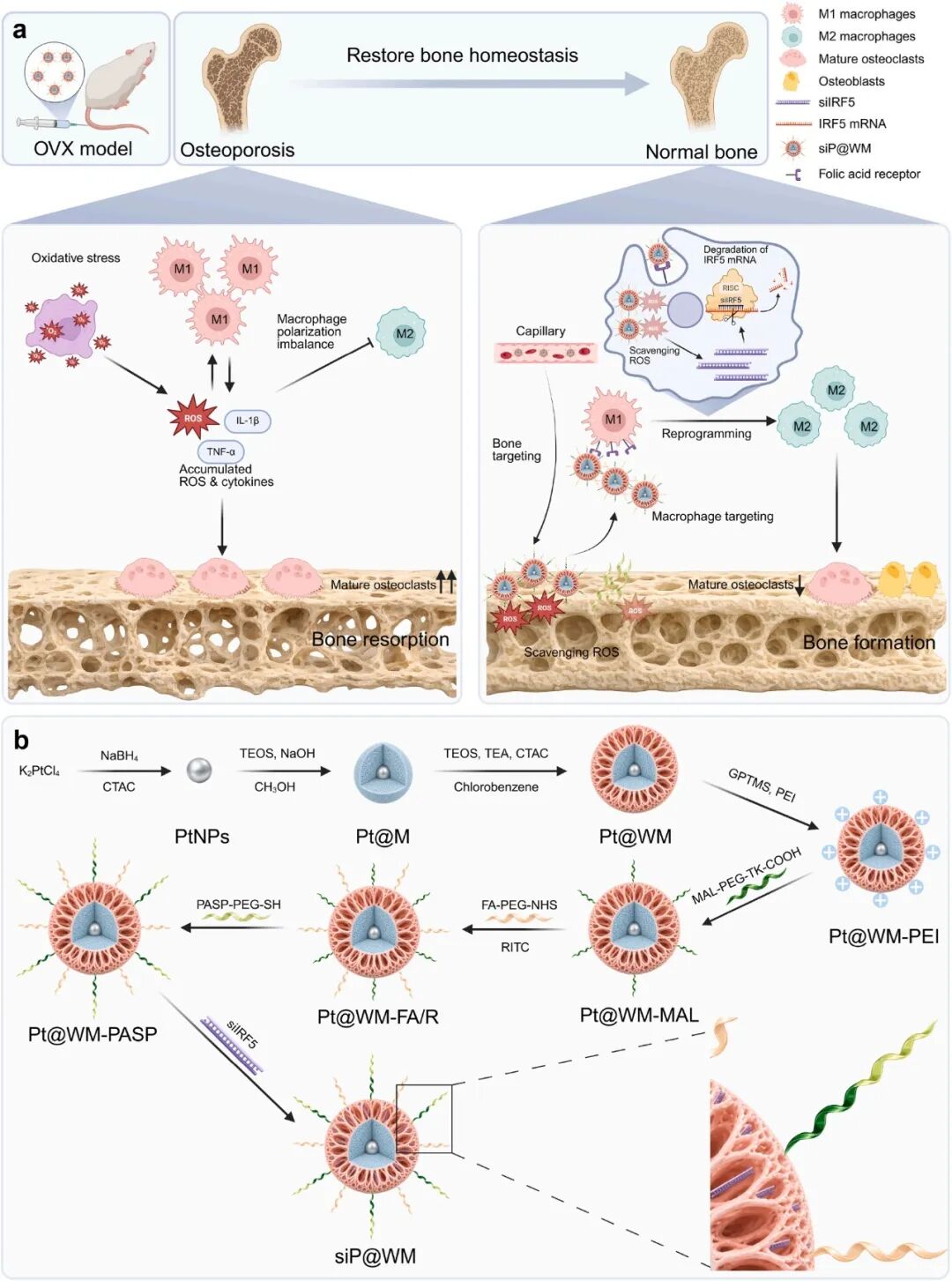
Postmenopausal osteoporosis is not merely caused by elevated osteoclast activity. Estrogen deficiency induces ROS accumulation and M1 macrophage polarization in bone tissue, which continuously provides osteoclastic stimuli and exacerbates pathological bone resorption. IRF5 serves as a critical regulator of M1 polarization, and silencing IRF5 holds promise for ameliorating the inflammatory bone microenvironment. Nevertheless, systemic delivery of siRNA suffers from inadequate bone enrichment and poor cell selectivity. Hydroxyapatite affinity alone cannot achieve targeted delivery to intraosseous M1 macrophages. Moreover, long-term excessive suppression of osteoclasts by conventional anti-resorptive drugs may also interfere with physiological bone remodeling. Therefore, a delivery strategy capable of simultaneous ROS scavenging and M1 macrophage modulation is highly desirable.
02 Main Content
This study designs a core–shell nanocarrier integrating platinum nanozyme, siRNA loading and programmed surface engineering. The mesoporous silica shell stabilizes the platinum core, and the enlarged mesopores are used to encapsulate siIRF5. PEI modification facilitates nucleic acid loading and endosomal escape. Long PASP-terminated PEG chains mediate enrichment in the bone matrix; ROS within the bone microenvironment triggers cleavage of the TK linker, shortening the outer chains, reducing adhesion to the bone matrix and exposing shorter folate-functionalized PEG chains, which improves recognition and uptake of folate-receptor-expressing M1 macrophages. The system simultaneously scavenges ROS and mediates IRF5 gene silencing, inhibiting osteoclastogenesis and improving bone remodeling with macrophages as the upstream regulatory node.
03 Study Design
Pt@WM was synthesized and sequentially modified with PEI, TK linkers, folate and PASP. Characterizations including morphology, pore size, zeta potential, surface chemistry, nucleic acid loading and protection, nanozyme activity and degradability were performed. In vitro, LPS was used to induce M1 macrophages, and cellular uptake, ROS scavenging, endosomal escape, IRF5 silencing and M2 markers were evaluated. Bone marrow-derived macrophages were treated with conditioned medium to detect RANKL-induced JNK/c-Jun phosphorylation, nuclear accumulation of c-Fos, osteoclastic genes, TRAP-positive multinucleated cells and F-actin rings. An ovariectomized mouse model was established, and tail vein administration was performed weekly. Assessments included bone mineral density, trabecular parameters, mechanical properties, osteoclasts, dynamic bone formation, serum bone turnover markers, transcriptomics, immunofluorescence and short-term safety.
04 Results
siP@WM exhibits a stable core–shell structure, enlarged mesopores and degradable silica shell. The platinum core retains CAT/POD/SOD-like activity, with efficient nucleic acid loading and good protective performance. Upon ROS response, adhesion to bone matrix decreases while folate exposure increases, leading to enhanced uptake by M1 macrophages; intracellular ROS is reduced, IRF5 expression is suppressed, and M2-associated markers are upregulated. Its conditioned medium reduces JNK/c-Jun phosphorylation and c-Fos nuclear accumulation in osteoclast precursors, downregulates osteoclast-related genes, and decreases the formation of TRAP-positive multinucleated cells and F-actin rings. In ovariectomized mice, siP@WM improves bone mineral density, bone volume fraction, trabecular thickness and number, restores mechanical properties, reduces osteoclast density and elevates bone formation rate, bringing serum bone turnover markers toward normal levels. Transcriptomic and histological results indicate attenuated AP-1-related inflammatory signaling, osteoclast differentiation and matrix degradation, downregulated M1 markers, upregulated M2 markers and reduced oxidative damage markers. No obvious abnormalities were observed in major organs in the short term.
05 Outlook
This work combines bone matrix enrichment with ROS-responsive cell targeting, integrating macrophage IRF5 silencing and nanozyme-mediated ROS scavenging into a single delivery system. It provides an instructive sequential targeting strategy for the regulation of the bone immune microenvironment. Future work should clarify the causal relationship between altered AP-1 signaling and suppressed osteoclastogenesis as well as the key cellular sources, which can be verified via conditional genetic intervention or single-cell analysis. Additional evaluations include therapeutic persistence after drug withdrawal, dose-response relationships, repeated administration and long-term safety of platinum accumulation. Comparisons with existing anti-resorptive strategies should be carried out. Further analysis is also needed for the coupling of bone formation and resorption, material degradation and clearance, and the robustness of this strategy in animal models of different ages and genders.
Source:
Bioactive Materials Pub
Date: 2026-10-14
DOI: 10.1016/j.bioactmat.2026.10.015
Zining Chen, Jinjin Wu, Yunyan Zhu, Anqi Tan, Junhao Deng, Yuting Niu, Weiran Li, Yunfei Zheng
We specialize in custom nano-medical functional materials. We conduct targeted development to tailor structure, particle size and surface modification for your experiments. Full characterization, iterative optimization and technical support are available for targeted delivery, bioimaging and nanomedicine studies. Send your evaluation plans to us.
Engineer Zhang: 17715390137
Engineer Chen: 18914047343