已传文件:photo/1793848284.png
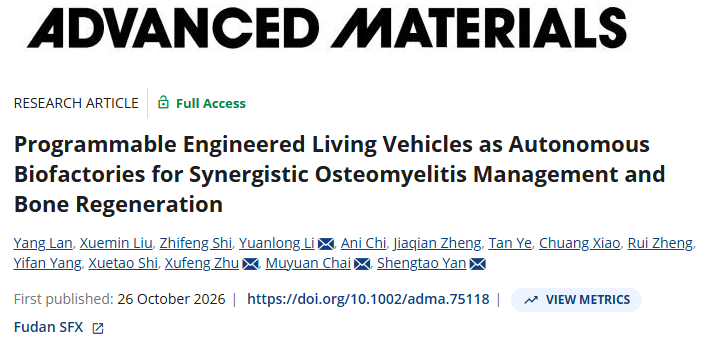
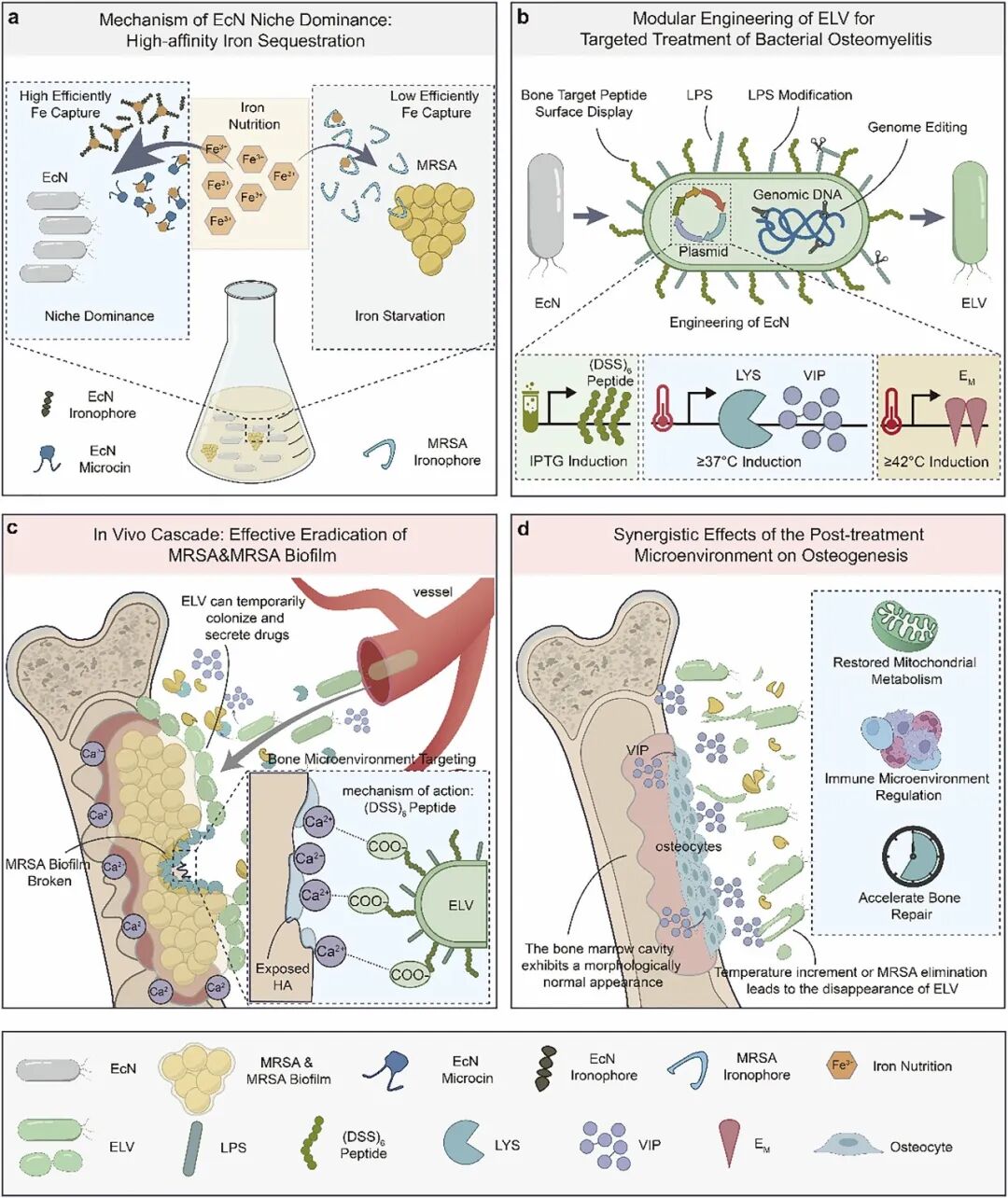
This study reports a programmable engineered living vehicle (ELV) based on E. coli Nissle 1917 (EcN). Equipped with bone-targeted surface display, temperature-controlled genetic logic circuits and biosafety modules, the ELV acts as an autonomous “biological factory” to locally produce lysostaphin and vasoactive intestinal peptide within infected bone tissue, enabling synergistic antibacterial and bone-regenerative therapy for methicillin-resistant Staphylococcus aureus osteomyelitis.
01
Research Background
Chronic osteomyelitis is characterized by biofilm barriers, insufficient local blood supply and limited drug penetration. Static materials and conventional antibacterial agents struggle to achieve both deep infection eradication and tissue repair. Living therapeutic agents possess the capacity for environmental sensing, colonization and sustained secretion. Nevertheless, challenges including bone targeting, spatiotemporal controllability, synergistic payload delivery and biosafety remain to be addressed.
02 Main Content
The ELV exploits siderophore and microcin-mediated iron competition of E. coli Nissle 1917 (EcN) to inhibit MRSA colonization. Surface-displayed DSS peptides enhance hydroxyapatite affinity. The temperature-controlled circuit initiates the secretion of lysostaphin (LYS) and vasoactive intestinal peptide (VIP) at host body temperature and enables heat-triggered self-lysis. LPS modification and a plasmid stabilization system are adopted to reduce immunogenicity and maintain genetic stability. LYS disrupts biofilms and bacterial cell walls, while VIP modulates macrophage polarization and promotes osteogenesis and angiogenesis.
03 Study Design
A multi-module genetic circuit was constructed, and surface display, temperature-responsive expression, bacterial lysis and plasmid stability were validated. In vitro evaluations included iron competition, antibacterial activity, anti-biofilm performance, cytocompatibility, immunomodulation and osteogenic capacity. A rat tibial osteomyelitis model induced by MRSA was established. In vivo imaging, bacterial burden quantification, histological examination, micro‑CT and transcriptomic analysis were performed, with vancomycin and component controls set for comparison.
04 Results
In this model, ELV can target and colonize infected bone tissue, reduce MRSA burden and residual biofilms, alleviate inflammation and facilitate an M2 macrophage-associated reparative phenotype. Histological and imaging results demonstrated improved trabecular architecture, bone volume and markers of osteogenesis and angiogenesis. The in vivo signal diminished after heat triggering. No obvious pathological abnormalities were observed in major organs, and haematological parameters remained unremarkable.
05 Outlook
Future work should dissect the individual contributions and synergistic mechanisms of iron competition, LYS and VIP. The sensitivity of the temperature switch and deep-tissue heat-triggering strategies can be optimized. Long-term immunogenicity, genetic stability and ecological safety require further assessment. Multi-signal logic gates and more sophisticated bone infection models may be introduced to refine the controllability and evaluation framework of living therapeutic materials.
Source:
Advanced Materials
Pub Date : 2026-10-26
DOI:10.1002/adma.75118
Yang Lan, Xuemin Liu, Zhifeng Shi, Yuanlong Li, Ani Chi, Jiaqian Zheng,
Tan Ye, Chuang Xiao, Rui Zheng, Yifan Yang, Xuetao Shi, Xufeng Zhu,
Muyuan Chai, Shengtao Yan
We specialize in custom nano-medical functional materials. We conduct targeted development to tailor structure, particle size and surface modification for your experiments. Full characterization, iterative optimization and technical support are available for targeted delivery, bioimaging and nanomedicine studies. Send your evaluation plans to us.
Engineer Zhang: 17715390137
Engineer Chen: 18914047343