已传文件:photo/1794194114.png
 Underwater manipulation of oil droplets and air bubbles is generally constrained by interfacial tension and low hydrodynamic resistance, which renders existing passive strategies incapable of on-demand, precise control of these objects. In this work, a shark-skin-inspired magnetoresponsive PVA hydrogel microplate array (SS‑MPHMA) with microgroove structures is fabricated via a 3D-printed template-assisted hydrogel freeze–thaw crosslinking strategy, enabling precise manipulation of underwater oil droplets and air bubbles in response to dynamic magnetic fields. Combining experimental characterization with ANSYS/COMSOL simulations, the effects of Fe₃O₄ content, microplate height, microplate thickness and plate spacing on structural strength, magnetic actuation behavior, underwater wettability and oil droplet adhesion are systematically investigated. The optimized SS‑MPHMA exhibits favorable mechanical stability, magnetic responsiveness and underwater superoleophobic/superaerophobic properties. Under a moving magnetic field, the microplate array can steadily transport heavy oil droplets, light oil droplets and air bubbles via continuous directional pushing. The oil droplet volume can reach 30 μL, with a maximum transport speed of 40 mm s⁻¹. Furthermore, SS‑MPHMA enables reversible switching of underwater circuits through precise bubble manipulation. In addition, benefiting from the strong water absorption capacity and magnetically driven oscillation of the hydrogel, SS‑MPHMA achieves active atomization in air, with a maximum water collection efficiency of approximately 400 mg cm⁻² h⁻¹. This work offers a new strategy for constructing magnetoresponsive underwater multiphase manipulation interfaces with low adhesion, and demonstrates promising applications in microfluidics, underwater sensing switches and atmospheric water harvesting.

This study was published in Chemical Engineering Journal under the title “Bioinspired magnetoresponsive hydrogel microplate array for droplet manipulation”.
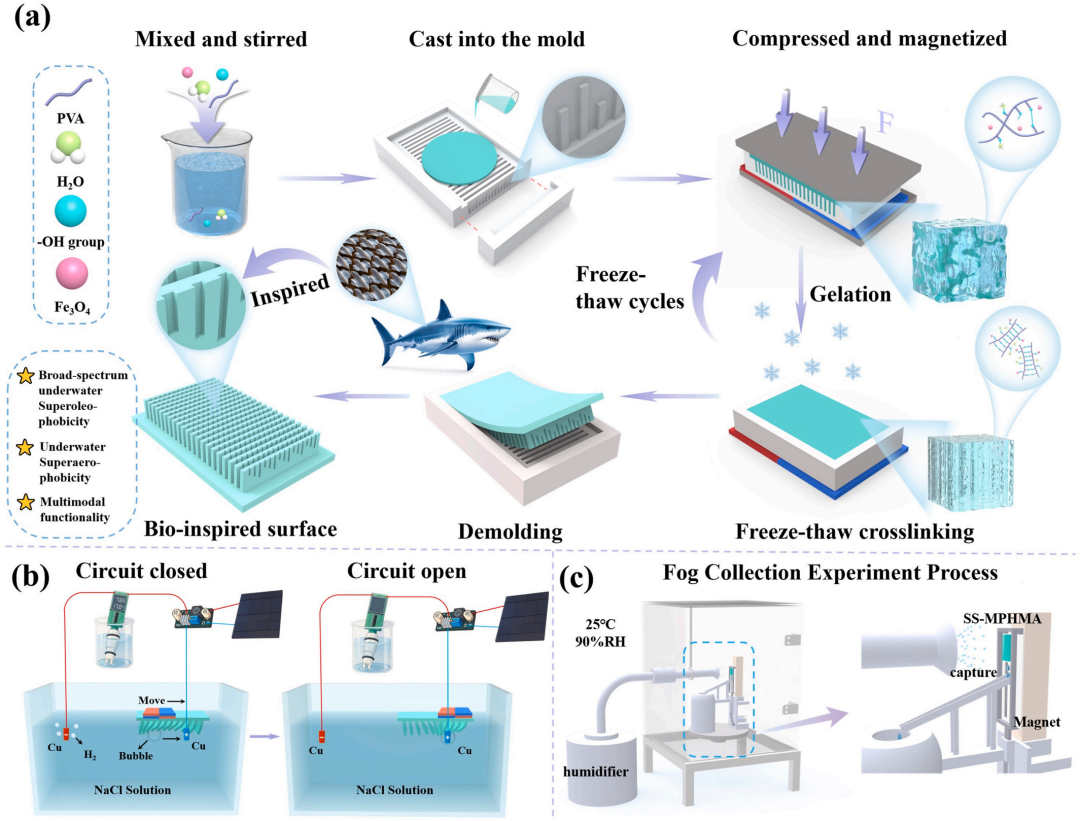 Figure 1
(a) Schematic illustration of the fabrication process of SS-MPHMA. (b) Switching of the underwater circuit between ON and OFF states. (c) Schematic diagram of the fog collection process.
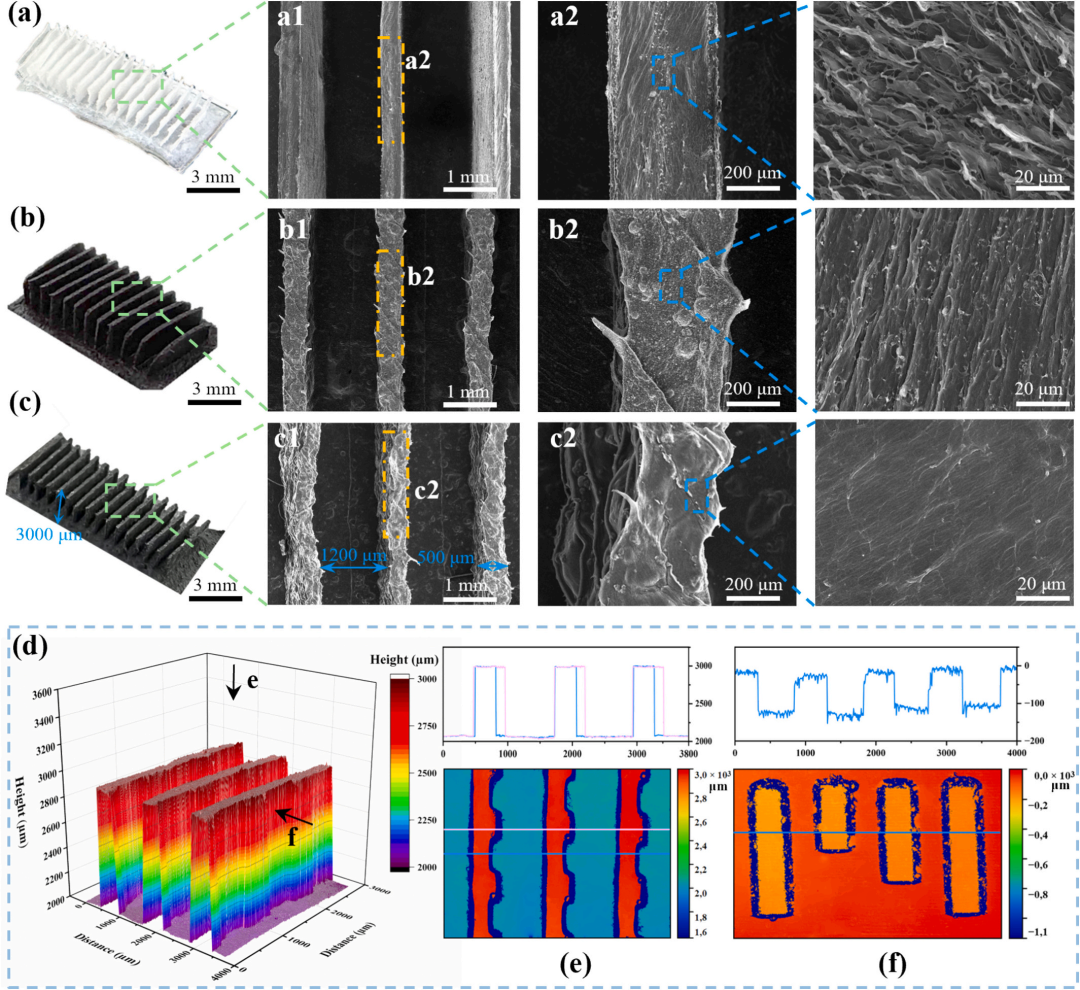
Figure 2
(a–c) SEM images of PVA, PVA@Fe₃O₄ and PVA@Fe₃O₄@SS microplate arrays. (d) 3D surface topography of PVA@Fe₃O₄@SS. (e) Top‑view image and the corresponding height profile. (f) Front and cross‑sectional views of the bioinspired shark‑skin microstructure.
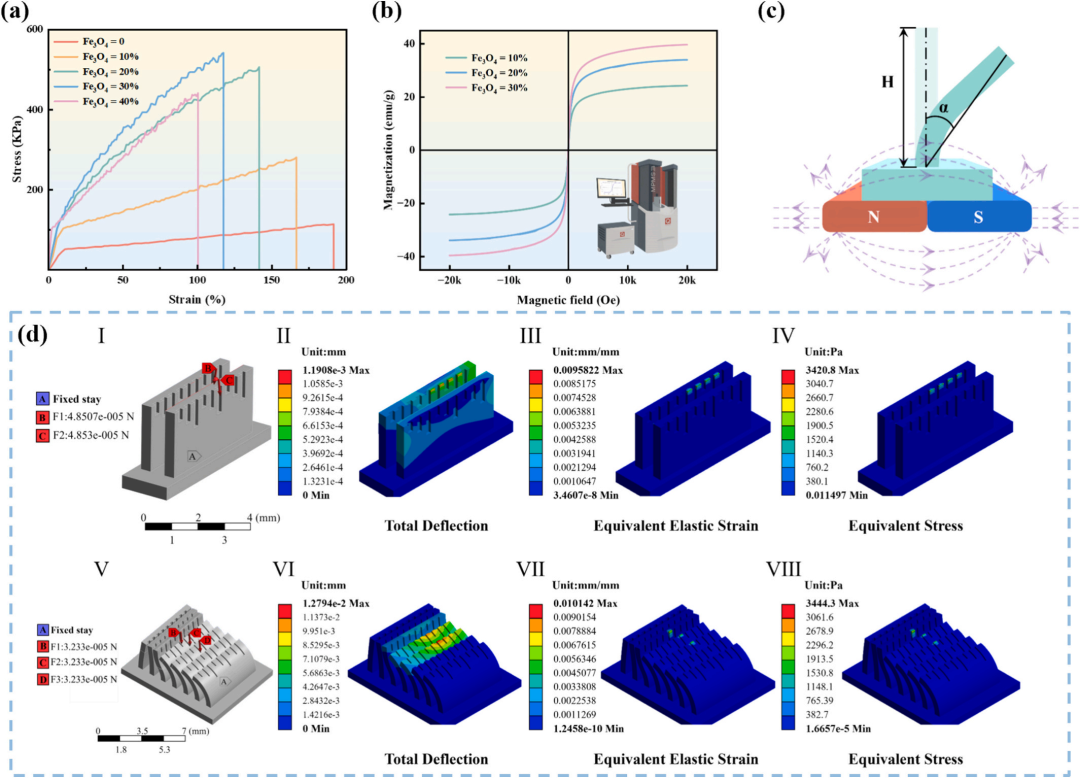
Figure 3
(a) Tensile stress–strain curves of PVA hydrogels with different Fe₃O₄ contents. (b) VSM results of hydrogels with varying Fe₃O₄ contents. (c) Schematic diagram of the bending angle of the microplate. (d) ANSYS structural mechanics simulation models of the microplate in upright and bent states.
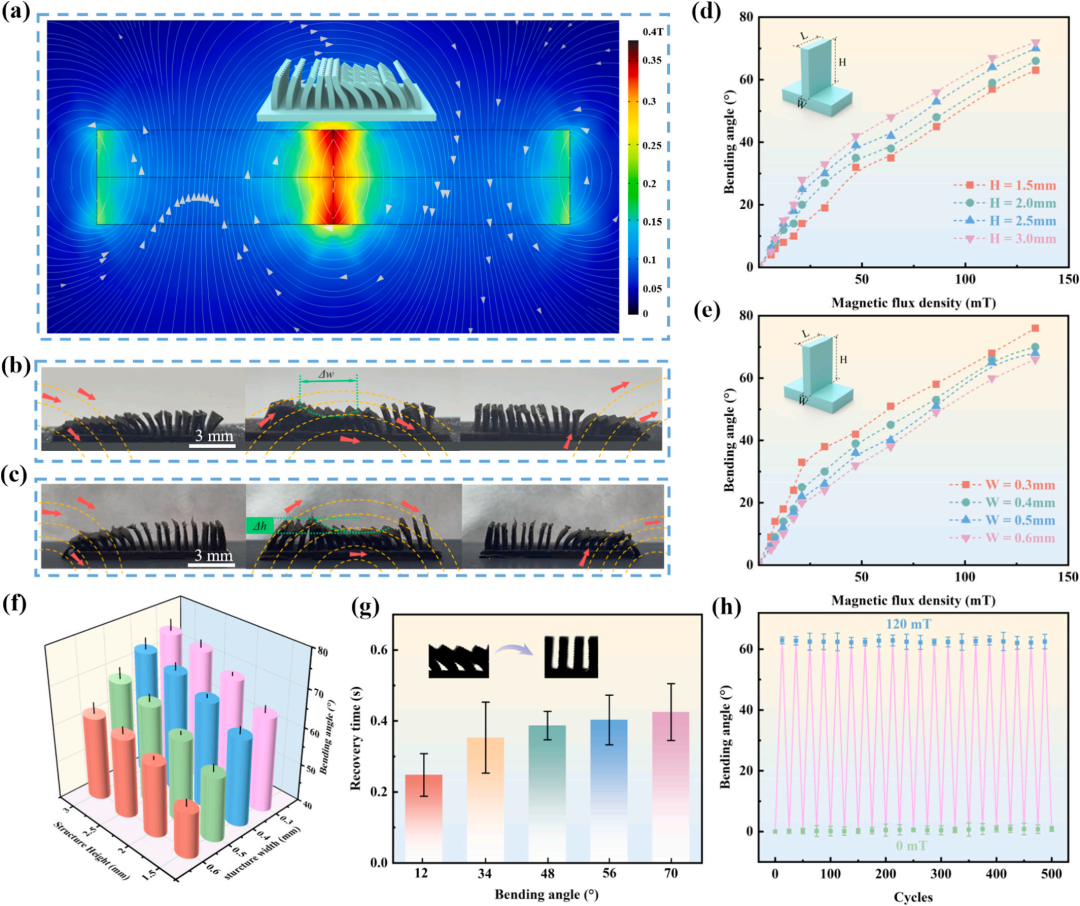
Figure 4
(a) Distribution of magnetic flux lines simulated by COMSOL. (b, c) Surface topography of the microplate array under 100 and 120 mT. (d) Bending angle as a function of microplate height and magnetic flux density, W = 0.4 mm. (e) Bending angle as a function of microplate width and magnetic flux density, H = 2.5 mm. (f) Summary of bending angle variations with microplate width and height at B = 120 mT. (g) Recovery time of the microplate array from the bent state to the upright state. (h) Cyclic bending stability of SS-MPHMA containing 20 wt% Fe₃O₄ under repeated magnetic actuation. Data in (d–h) are presented as mean ± standard deviation (SD) of three independent measurements (n = 3).
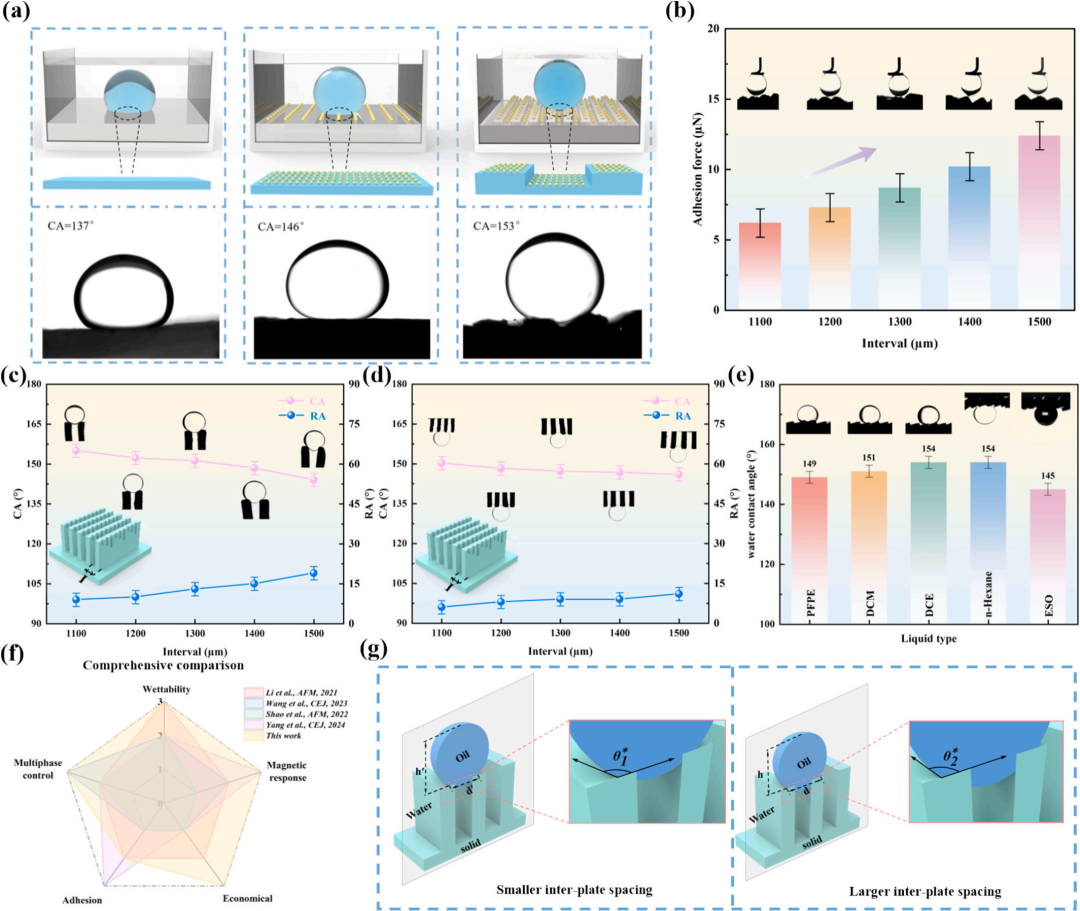
Figure 5
(a) Schematic illustration of the underwater wettability of PVA, PVA@Fe₃O₄ and PVA@Fe₃O₄@SS. (b) Effect of plate spacing on the adhesion of underwater oil droplets. (c) Underwater oil contact angle and sliding angle of dichloromethane at different plate spacings. (d) Variation in underwater oil contact angle and sliding angle of n-hexane with plate spacing. (e) Oleophobic contact between the microplate array and different oil droplets underwater. (f) Comprehensive performance comparison with representative literature. (g) Effect of plate spacing on underwater oil droplet penetration and apparent contact angle. Data in (b–e) are presented as mean ± standard deviation (n = 3).
Summary
Underwater oil droplets and air bubbles are difficult to manipulate on demand with high precision owing to low interfacial tension and hydrodynamic resistance. In this study, a shark-skin-inspired magnetoresponsive PVA microplate array was fabricated via 3D-printed template-assisted freeze–thaw crosslinking. Combined with microgroove structures and Fe₃O₄ doping, the array can be magnetically actuated. Integrating experiments with ANSYS and COMSOL simulations, the Fe₃O₄ content, microplate height, thickness and spacing were tuned to balance structural strength, magnetic bending performance, underwater wettability and oil droplet adhesion. The optimized array enables continuous transportation of heavy oil droplets, light oil droplets and air bubbles under a moving magnetic field, with oil droplet volumes up to 30 μL and a maximum transport speed of ~40 mm s⁻¹.
The array also achieves reversible switching of underwater circuits through precise bubble manipulation, converting interfacial variations into electrical signals. Benefiting from the water absorption capacity of PVA hydrogel and magnetically driven oscillation, it supports active fog collection in air, with a water-harvesting efficiency of approximately 400 mg cm⁻² h⁻¹. This work offers a new strategy for constructing magnetoresponsive underwater multiphase manipulation interfaces with low adhesion, with promising applications in microfluidics, underwater sensing switches and atmospheric water harvesting.
References:
DOI: 10.1016/j.cej.2026.181985
We specialize in custom nano-medical functional materials. We conduct targeted development to tailor structure, particle size and surface modification for your experiments. Full characterization, iterative optimization and technical support are available for targeted delivery, bioimaging and nanomedicine studies. Send your evaluation plans to us.
Engineer Zhang: 17715390137
Engineer Chen: 18914047343