已传文件:photo/1794365693.png
 This study was published in Nature Communications under the title “Dynamic coupling enables impulsive ejection in a hydrogel catapult”.
Frontiers in Bio-Nanotechnology
Jetting dynamics can endow microrobots with high-speed, cross-scale locomotion and noncontact manipulation capabilities. Herein, we propose a dynamically coupled ejection strategy to generate and transmit kinetic energy in microrobots. We demonstrate this strategy using a bilayer hydrogel catapult, in which rapid phase-transition-driven deformation is dynamically coupled between the projectile and the substrate, yielding remarkable power output and kinetic energy release. The resulting ejection-driven system achieves a broad projectile mass range (0–1000 times the catapult’s own weight), a launch velocity of 16.6 m/s for projectiles of identical mass, and a power density exceeding 8.74×10⁴ W/kg, outperforming most natural and engineered miniature catapults. As a proof-of-concept, we present a biopsy robot powered by the hydrogel catapult, which ejects a coarse needle in a single operation to acquire deep tissue samples. These findings establish a platform for advancing the fast locomotion and high-power output of miniature soft robots.
Paper Snapshot
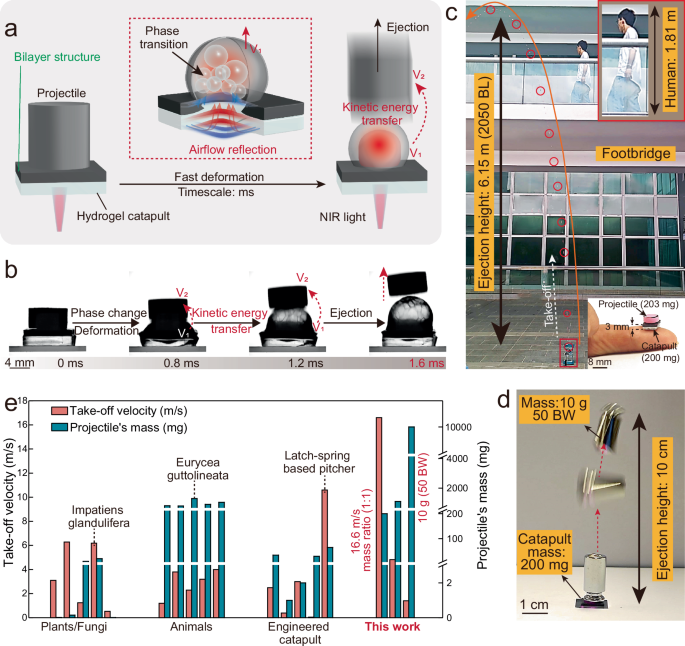
Figure 1
Panel a shows a schematic illustration of the ejection-driven mechanism. Panel b presents high-speed camera images extracted from Supplementary Movie 1, demonstrating the ejection process of the hydrogel catapult. Panel c is a superimposed image from Supplementary Movie 2, indicating the ejection height of the near-infrared-light-driven catapult. Inset: Size comparison of the hydrogel catapult and projectile used in Figure 1c. The projectile has a mass of 203 mg, comparable to the mass of the catapult (200 mg). Panel d displays a superimposed image from Supplementary Movie 2, showing the ejection of a projectile weighing 10 g (50 times the mass of the hydrogel catapult). Panel e compares the take-off velocity and projectile mass of the light-driven hydrogel catapult, engineered catapults, as well as plants, fungi and animals with ballistic ejection capabilities in nature. Note that the plotted data are limited to miniature biological and engineered catapults at the milligram-to-gram scale. The representative images in Figure 1 (high-speed snapshots and superimposed trajectories) are from independent experiments repeated at least three times with similar outcomes; only representative data are shown.
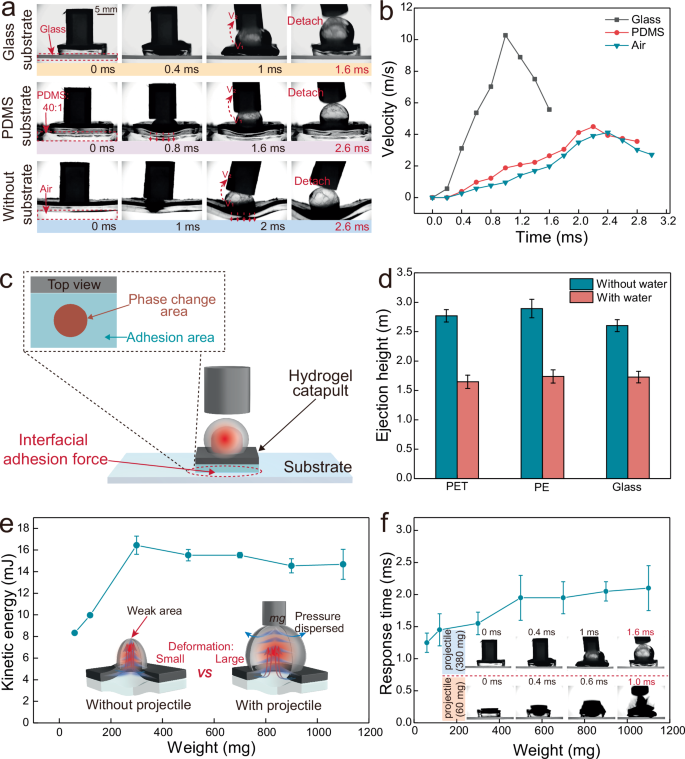
Figure 2
a Comparison of deformation and actuation time of hydrogel catapults on glass substrates, PDMS substrates, and free-standing (substrate-free) conditions. Note that the projectile mass is 380 mg.
b Velocity profiles of the projectile during actuation on glass, PDMS and free-standing supports.
c Schematic illustration of the interfacial adhesion between the hydrogel catapult and the substrate.
d Comparison of ejection heights with and without water lubrication (to block interfacial adhesion) on different substrates. Data points denote mean ± standard deviation (n = 4).
e Kinetic energy acquired by projectiles of different masses and the corresponding actuation time of the hydrogel catapult. Note that all projectiles are fabricated into cylinders (10 mm diameter, 10 mm height) with varied densities to reduce measurement errors. Data points denote mean ± standard deviation (n = 4). Representative images in Figure 2 (high-speed camera snapshots) are from independent experiments repeated at least three times with similar outcomes; only representative data are shown.
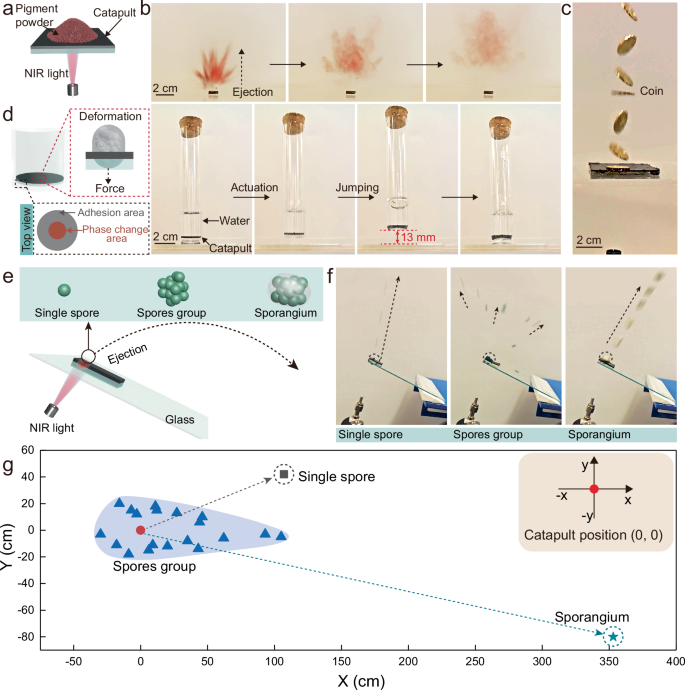
Figure 3
a Schematic illustration and b snapshots extracted from Supplementary Movie 4, demonstrating the powder ejection process.
c Superimposed image from Supplementary Movie 4 showing the ejection of a coin.
d Schematic illustration and snapshots extracted from Supplementary Movie 4, presenting the hydrogel catapult as an actuator to drive burette jumping.
e Schematic of the physical model representing sporangium-like ejection behavior.
f High-speed images illustrating the ejection motion of simulated projectiles (i.e., single spores, spore clusters and sporangia).
g Position distributions of three representative ejection events.
Representative images in Figure 3 (photographs and superimposed trajectories) are from independent experiments repeated at least three times with similar outcomes; only representative data are shown.
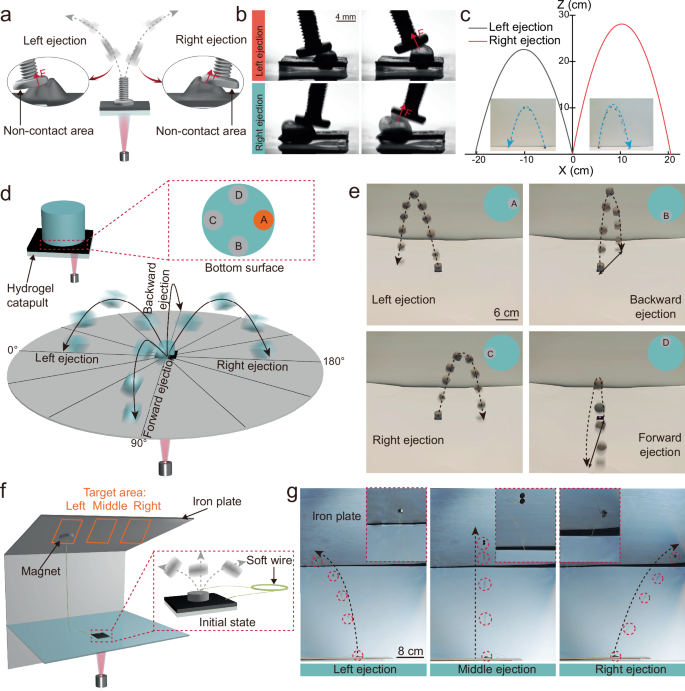
Figure 4
a Schematic illustration showing the principle for directional control of ejection motion.
b High-speed images at the moment of activation and c launch trajectories extracted from Supplementary Movie 5, demonstrating leftward and rightward ejection motion. Note that the light intensity and projectile mass are 15.68 W/cm² and 2280 mg, respectively.
d Schematic illustration and e superimposed images from Supplementary Movie 5, exhibiting multi-directional ejection capability.
f Schematic illustration of magnetic ejection toward a predefined target area on an iron plate and g trajectory analysis.
Representative images in Figure 4 (high-speed camera snapshots and superimposed trajectories) are from independent experiments repeated at least three times with similar outcomes; only representative data are shown.
Reference Information
Nature Communications (IF 18.1)
Pub Date: 2026-09-07
DOI: 10.1038/s41467-026-77391-6
We specialize in custom development of functional nanomedicine materials. We can tailor materials according to experimental requirements, tuning material structure, particle size and surface modification. Full characterization services are provided. Solutions are iteratively optimized with continuous technical support throughout the project. Our services support research projects including targeted delivery, bioimaging, and nanotheranostics. Feel free to send your specifications for solution evaluation.
Mr. Zhang: +86 17715390137
Mr. Chen: +86 18914047343