已传文件:photo/1794449562.png

This study was published in Nature Communications under the title “Live-shaping of hydrogel thin films with light”.
Frontiers in Bionanomaterials
Photoresponsive hydrogels are appealing materials for mimicking dynamic microstructures found in nature, offering a platform for tunable devices in photonics, sensing and biomedicine. Nevertheless, such systems commonly suffer from limited spatial resolution and slow response times, which restrict their practical use in high-speed or high-precision applications. Herein, we report a photoresponsive hydrogel thin-film platform capable of rapid, reconfigurable surface modulation with submicrometer spatial resolution and an actuation frequency up to 2 Hz. This system leverages photoswitchable host–guest interactions to induce reversible contraction–expansion under patterned illumination. Dual-wavelength control enables dynamically migrating surface features that can transport micro-objects in real time. This approach is further extended to free-standing films, whose functionality is demonstrated in laser beam steering. Moreover, surface patterns can be stabilized by drying and erased via humidity, paving an avenue toward rewritable sensor tags.
Literature Spotlight
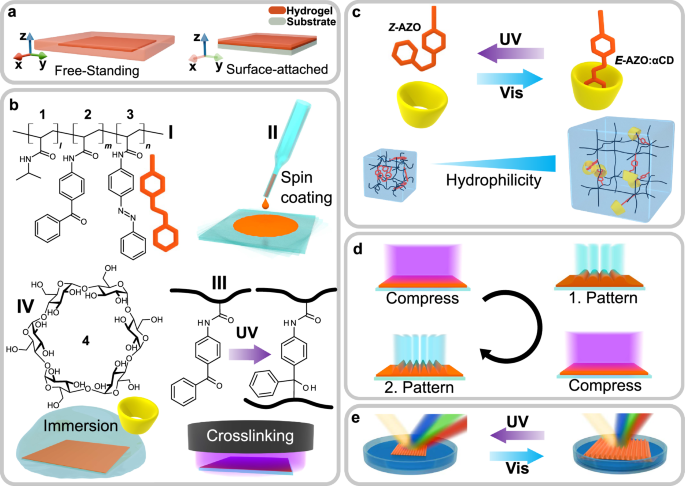 Figure 1
a Comparison of isotropic expansion along the xyz directions in free-standing films versus anisotropic expansion along the z direction in surface-attached films. b (I) Oligomer composition: (1) N-isopropylacrylamide, (2) 4-acrylamidobenzophenone (BP) photocrosslinker, and (3) 4-acrylamidoazobenzene (AZO) moiety. (II–IV) Film fabrication via spin-coating, photocrosslinking, and subsequent functionalization by immersion in aqueous solution containing (4) α-cyclodextrin (αCD). c Working mechanism: the E-AZO:αCD inclusion complex increases network hydrophilicity and thus triggers swelling; dissociation of Z-AZO reduces hydrophilicity instead. d Reconfigurable photopatterning: spatially controlled inclusion and swelling can be achieved through UV-induced compression followed by spatially modulated visible-light illumination. The features can be erased and rewritten via subsequent optical cycles. e Phototunable diffractive structures demonstrated by the contraction–swelling of surface relief gratings (SRG) on free-standing films.
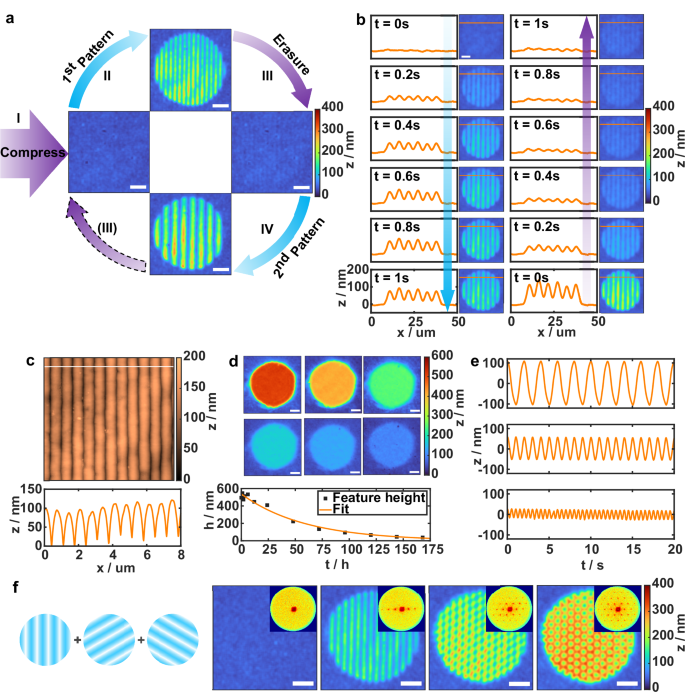
Figure 2
Patterning–erasure cycles of two types of surface relief gratings (SRGs) on hydrogel thin films. The process consists of: (I) UV-induced compression (365 nm), (II) visible-light patterning (488 nm) to form SRGs with a 3 µm period, (III) UV erasure, and (IV) subsequent patterning of SRGs with a 5 µm period. b Kinetics of SRG formation and erasure under a 488 nm interference pattern and uniform 365 nm illumination. Profiles were extracted along the indicated lines (intensity: 200 mW cm⁻²; exposure time: 0.2 s). c Atomic force microscopy image and surface profile of an 800 nm-period grating patterned at 488 nm (100 mW cm⁻², 2 s). d Relaxation of cylindrical surface features, showing topography (top) and exponentially fitted decay of feature height over time (bottom). e Thickness modulation of the hydrogel film at frequencies of 0.5 Hz (top), 1 Hz (middle), and 2 Hz (bottom). Irradiation intensities: 50 mW cm⁻² (365 nm) and 200 mW cm⁻² (490 nm). f Hexagonal 2D SRG patterning via sequential 1D exposure (3 µm period) with a 60° rotation. Conditions: 488 nm, 200 mW cm⁻², 300 ms. All experiments were performed in 100 mg mL⁻¹ aqueous αCD solution. DHM images were obtained from silver-coated samples; scale bar: 10 µm.
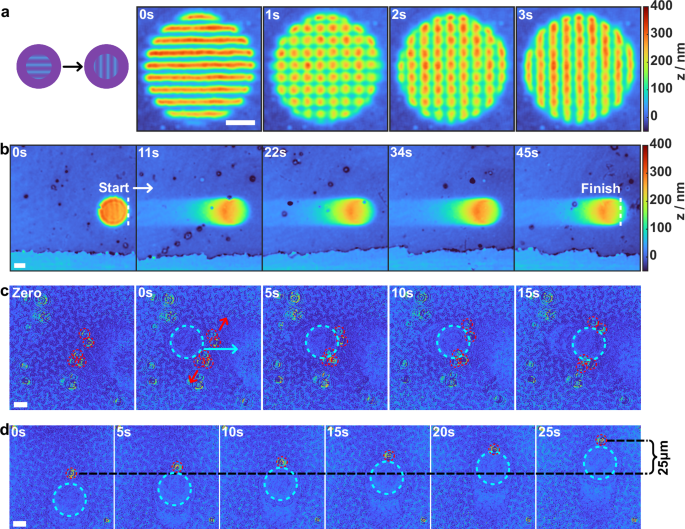
Figure 3
a Dynamic reorientation of a one-dimensional grating (SRG), rotating the grating vector by 90° from vertical to horizontal. Illumination: 50 mW cm⁻² at 365 nm; 400 mW cm⁻² at 488 nm. b Lateral movement of a cylindrical protrusion, travelling 440 µm across the hydrogel surface within 45 s. Illumination: 20 mW cm⁻² at 365 nm; 100 mW cm⁻² at 488 nm. c Particle separation achieved by translating the cylindrical protrusion. Illumination: 100 mW cm⁻² at 365 nm; 200 mW cm⁻² at 488 nm. d Transport of a single particle using the cylindrical protrusion under the same illumination conditions as in panel c. Translated particles and protrusions are highlighted in red and light blue in c and d, respectively. Data in a and b were obtained from silver-coated samples; samples in c and d were uncoated. All experiments were carried out in 100 mg mL⁻¹ aqueous αCD solution. Scale bar: 10 µm.
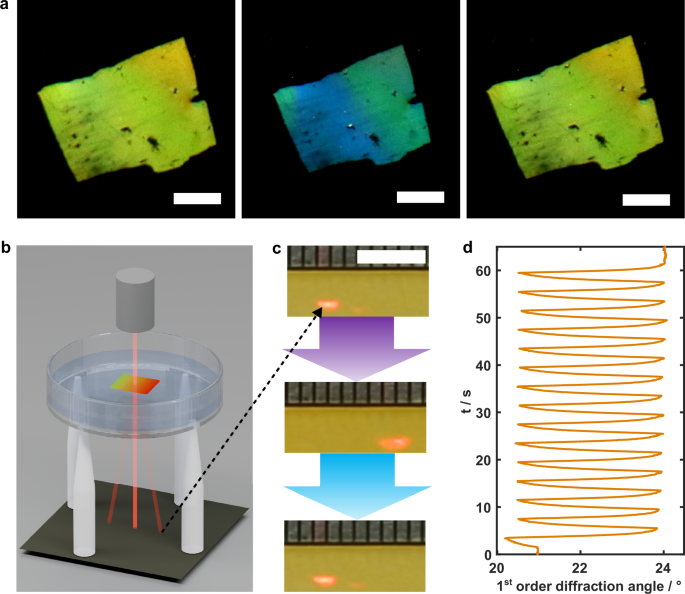
Figure 4
a Tuning of dynamic structural color during 0.25 Hz contraction–swelling cycles of a free-standing hydrogel film at a fixed observation angle. Scale bar: 1 mm. b Schematic illustration of programmable laser beam steering. A free-standing film pre-inscribed with photonic crystal gratings (SRG) floats in α-cyclodextrin solution; a laser beam incident from above generates a transmitted diffraction pattern. c Spatiotemporal control of beam deflection. Snapshots showing the position variation of the first-order diffracted beam within a single 0.25 Hz actuation cycle. Scale bar: 5 mm. d Continuous beam-steering performance. Angular displacement of the first-order diffraction spot over 1 min of cycling at 0.25 Hz. The illumination intensity of both 365 nm and 490 nm lasers was 100 mW cm⁻² in all experiments.
Reference Information
Nature Communications (IF: 18.1)
Pub Date: 04 April
2026
DOI: 10.1038/s41467-026-71438-4
We specialize in custom nano-medical functional materials. We conduct targeted development to tailor structure, particle size and surface modification for your experiments. Full characterization, iterative optimization and technical support are available for targeted delivery, bioimaging and nanomedicine studies. Send your evaluation plans to us.
Engineer Zhang: 17715390137
Engineer Chen: 18914047343