已传文件:photo/1794880363.png
 Background

This study, entitled “Translation-driven design: development of an antibiotic-loaded hydrogel for the management of orthopaedic device-related infection”, was published in Bioactive Materials.
Bio-Nano Frontiers
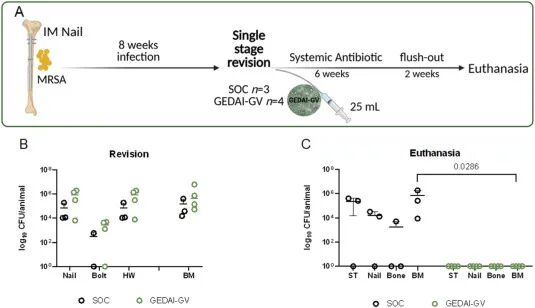
Orthopaedic device-related infection (ODRI) represents a severe complication that frequently requires multiple revision surgeries and prolonged antibiotic therapy. Injectable and degradable biomaterials capable of delivering and sustaining high local antibiotic concentrations at the surgical site may improve therapeutic outcomes without the need for additional surgical intervention. This study describes an antibiotic-eluting delivery gel (GEDAI) for the local administration of tobramycin (T), gentamicin (G), or gentamicin–vancomycin (GV). GEDAI was designed with an emphasis on translational potential and ease of intraoperative handling. GEDAI exhibited storage and loss moduli, shear-thinning behaviour and elastic recovery properties suitable for intraoperative application, favourable adhesion to stainless steel and tissues, yet low adhesion to surgical gloves. In vitro assays demonstrated that GEDAI exerted no adverse effects on the viability of fibroblasts, macrophages and endothelial cells, or the osteogenic differentiation of human bone marrow mesenchymal stem cells (hBMSCs). Compared with antibiotic-free GEDAI, antibiotic-loaded GEDAI significantly reduced both planktonic and biofilm forms of methicillin-susceptible and methicillin-resistant Staphylococcus aureus (MSSA and MRSA) following exposure (p < 0.05). In independent in vivo studies involving three sheep, GEDAI-T achieved a peak local concentration exceeding 2000 μg/mL within 2 h. It markedly reduced bacterial burdens in two implant-retention models (GEDAI-T or GEDAI-G) and achieved complete infection eradication in an implant-exchange model (GEDAI-GV). GEDAI directly addresses two unmet clinical needs for ODRI: achieving bactericidal local concentrations without systemic toxicity and providing an off-the-shelf formulation. Antibiotic-loaded GEDAI formulations hold promise for improving treatment outcomes in refractory infection cases and may reduce healthcare costs and patient burdens associated with the management of postoperative infection.
Literature Snapshot
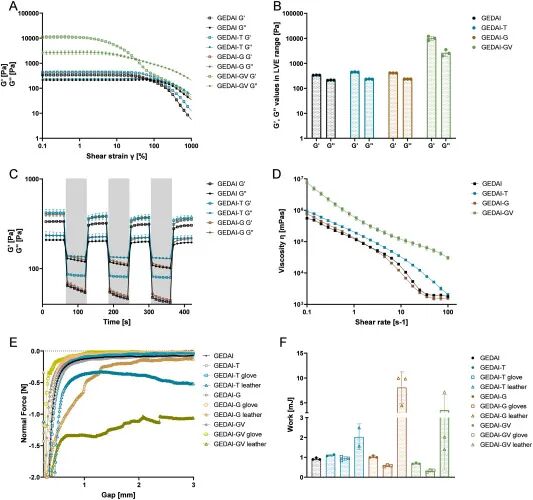
Figure 1
Rheological characterization of GEDAI, GEDAI-T, GEDAI-G and GEDAI-GV. All formulations (n = 1 independent sample with three technical replicates): (A) Amplitude sweep showing storage modulus (G′) and loss modulus (G″) as a function of shear strain (γ); (B) Determination of the linear viscoelastic region (LVE); (C) Elastic recovery sweep (Pa) over time under low (1%) and high (300%) shear strain (γ), with the high-strain segment highlighted in grey; tests performed at a constant frequency of 10 rad s⁻¹; (D) Viscosity as a function of shear rate (s⁻¹); (E) Adhesion test conducted at a gap velocity of 0.1 mm s⁻¹, with gap plotted as a function of normal force (N); (F) Work of adhesion (mJ), calculated as the area under the force–gap curve. The antibiotic concentrations in the GEDAI formulations are as follows: GEDAI-G: 1% gentamicin sulfate; GEDAI-T: 2% tobramycin sulfate; GEDAI-GV: 1% gentamicin sulfate and 4% vancomycin.
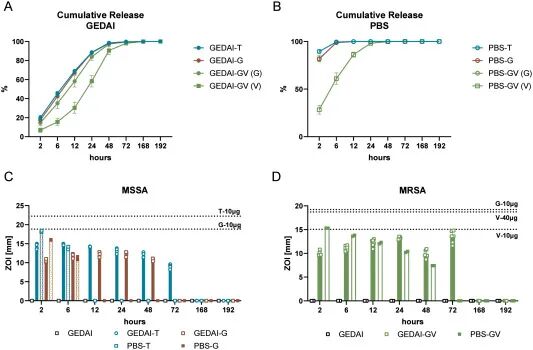
Figure 2
In vitro antibiotic release from GEDAI and antimicrobial activity of the released antibiotics. (A) Cumulative in vitro release of T, G and G/V from GEDAI over 8 days, expressed as the percentage of total antibiotic released. (B) Cumulative in vitro release of T, G and G/V in the PBS control group over 8 days. For GEDAI-GV, separate curves represent the release of G and V. (C) ZOI assay showing the antimicrobial activity of antibiotics released from GEDAI-T, GEDAI-G and GEDAI-GV against MSSA, and (D) against MRSA. The dashed lines in C and D represent control discs loaded with defined amounts of each antibiotic (T: 10 μg, G: 10 μg, V: 40 μg). Two‑way analysis of variance (two‑way ANOVA) followed by Tukey’s multiple comparison test was used for statistical analysis. n = 3 technical replicates for each formulation. Antibiotic concentrations of GEDAI formulations: GEDAI-G: 1% gentamicin sulfate; GEDAI-T: 2% tobramycin sulfate; GEDAI-GV: 1% gentamicin sulfate and 4% vancomycin; MSSA: methicillin‑susceptible Staphylococcus aureus; MRSA: methicillin‑resistant Staphylococcus aureus.
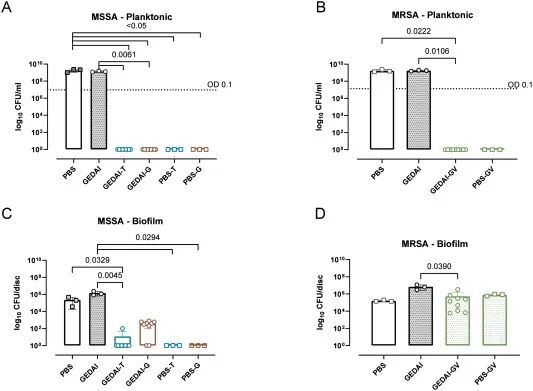
Figure 3
Antimicrobial activity of antibiotic‑loaded hydrogels against planktonic and biofilm forms of methicillin‑susceptible Staphylococcus aureus (MSSA) and methicillin‑resistant Staphylococcus aureus (MRSA). (A) Planktonic MSSA (OD₆₀₀ = 0.1) was exposed to GEDAI‑T, GEDAI‑G, PBS solutions containing the corresponding antibiotics, PBS alone, or antibiotic‑free GEDAI for 24 h. (B) Planktonic MRSA (OD₆₀₀ = 0.1) was exposed to GEDAI‑GV, PBS solution containing the corresponding antibiotics (GV), PBS alone, or antibiotic‑free GEDAI for 24 h. (C) MSSA biofilms were grown on titanium discs for 48 h, followed by 24 h exposure to GEDAI‑T, GEDAI‑G, PBS solutions containing the corresponding antibiotics, PBS alone, or antibiotic‑free GEDAI. (D) MRSA biofilms were grown on titanium discs for 48 h, followed by 24 h exposure to GEDAI‑GV, PBS solution containing the corresponding antibiotics, PBS alone, or antibiotic‑free GEDAI. Statistical analysis was performed using the Kruskal–Wallis test followed by Dunn’s multiple comparison test for post‑hoc analysis. n = 3 technical replicates for each formulation. A value of 1 was arbitrarily assigned to sterile culture samples for visualization on the logarithmic axis. Antibiotic concentrations of GEDAI formulations: GEDAI‑G: 1% gentamicin sulfate; GEDAI‑T: 2% tobramycin sulfate; GEDAI‑GV: 1% gentamicin sulfate and 4% vancomycin; MSSA: methicillin‑susceptible Staphylococcus aureus; MRSA: methicillin‑resistant Staphylococcus aureus.
Reference information
Bioactive Materials (IF: 23.6)
Pub Date: 09 June 2026
DOI: 10.1016/j.bioactmat.2026.04.033